The 7 Best Hi-Hat Stands of (2026) for Smooth and Stable Playing

A hi-hat stand controls how reliably the cymbals open, close and return under your foot. A stable base, predictable spring tension and a pedal that fits beside your other hardware matter more than a dramatic feature list. The seven stands below serve different layouts, from a simple three-leg kit to a remote hat position.
A stand’s pedal and clutch affect how easily you can move between tight closed notes, open accents and a foot chick. Check how the pedal feels with your own cymbals, and make sure the clutch holds the top cymbal securely. A smooth action is useful, but the stand also has to fit the space available at your kit.
Height memory locks are useful if you pack the stand for rehearsals or gigs. They help you return to a familiar setup without measuring the tube every time. They are a convenience, not a requirement for a stand that stays assembled at home.
Two-leg stands leave more room beside a double bass pedal. A three-leg stand spreads its support around the cymbals and may feel steadier on some floors. Swiveling legs can reduce that space tradeoff, so test the footprint with the rest of your pedals rather than choosing by leg count alone.
My overall pick is the Pearl H930 Hi-Hat Stand, Demonator Style. Its swiveling, double-braced tripod and adjustable spring tension make it adaptable for a conventional kit, while the long footboard suits players who like extra room to place the foot.
For a lower-cost conventional setup, I recommend the Gibraltar 5707 Double Braced. It has double-braced swiveling legs without the heavier feature set of the premium stands.
Contents
- The 7 Best Hi-Hat Stands of (2026)
- 1. Pearl H930 Hi-Hat Stand, Demonator Style
- 2. Gibraltar 5707 Double Braced
- 3. Tama HH315D Speed Cobra 310 Hi-Hat Stand
- 4. Griffin Remote Hi Hat Stand with Foot Pedal
- 5. Yamaha HS-740A
- 6. PDP by DW PDHH813 800 Series Three-Leg Hi-Hat Stand
- 7. DW DWCP3500TA Hi-Hat Stand
- How do you set up a Hi-Hat Stand?
- What is the Difference between two-legged and three-legged Stands?
- Why does my stand keep loosening?
- What to look for in a hi-hat stand when buying?
- Summary
The 7 Best Hi-Hat Stands of (2026)


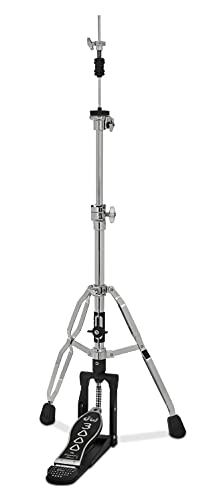
Let’s compare these in more detail.
1. Pearl H930 Hi-Hat Stand, Demonator Style
Pearl’s H-930 earns the top position because it combines a supportive double-braced tripod with useful adjustments, without asking the reader to commit to a two-leg stand. Its Demon-style long footboard is a distinct fit choice, especially if you move your foot position as you play.
The H-930 uses a chain-driven pedal and a swiveling Trident tripod. The swivel helps when another pedal needs to sit close to the hi-hat, although the three legs still take more floor space than the dedicated two-leg models below.
A spring tension dial lets you change the pedal resistance to suit your cymbals and preferred feel. The die-cast joints and memory stops also make it easier to return to a familiar height after moving the stand.
This is a sturdy midweight choice rather than the lightest stand to carry. Its double-braced legs and large feet provide a broad base, but players whose double bass pedal leaves almost no room may prefer the Tama or DW two-leg option.
2. Gibraltar 5707 Double Braced
Gibraltar’s 5707 is the budget pick for a straightforward stand that can still work beside a crowded pedal setup. It gives you a medium-weight build and a swiveling, double-braced tripod at a lower cost than the H-930.
Its three legs and chain-drive Fast Touch footboard keep the layout familiar. The standard clutch is simple to maintain, while the swiveling base gives more placement freedom than a fixed tripod.
The 5707 is a sensible choice when transport weight and cost matter more than extensive adjustments. Its smaller footprint may suit a compact kit, though you should check its stability with your own cymbal weight and playing force.
A quality hi-hat stand is a good investment, no matter if you are playing a professional or some mid-grade drums.
3. Tama HH315D Speed Cobra 310 Hi-Hat Stand
Tama now labels the HH315D as the Speed Cobra 310 hi-hat stand; older listings call the same model Speed Cobra 315. It serves the player who needs two-leg pedal clearance and a long footboard without moving to Tama’s higher-tier 915 model.
The HH315D uses direct-pull action, a six-position spring tension adjustment and a swiveling foot. The two-leg base can make room for a second bass drum pedal. It also has a rod protector for transport, a practical detail if you regularly break down the kit.
Choose the Tama if a compact pedal cluster is the main constraint. Its height range of about 28 to 36 5/8 inches should be checked against your seated playing position. The Pearl remains the more general recommendation when a three-leg base fits comfortably.
4. Griffin Remote Hi Hat Stand with Foot Pedal
The Griffin MD-H40R is the specialist remote option here. Its cable separates the pedal position from the cymbal position, letting you place the hats where a conventional stand cannot reach. It is a different setup decision from the six floor stands.
A remote hat can help an open-handed layout or a kit with extra percussion on the usual hi-hat side. Plan the cable route and mounting point before buying; the cymbal end needs secure support, and cable routing adds setup work.
The Griffin is offered as a six-foot cable kit with pedal and mount hardware. It is worth considering when cymbal placement is the goal, but a standard stand is simpler if the hats can stay beside the left foot.
Check the supplied holder against your cymbal stand or rack clamp before ordering. A separate clamp may still be needed for your particular hardware. The mounting point should remain rigid while you work the pedal.

5. Yamaha HS-740A
Yamaha’s HS-740A is the lighter single-braced alternative in this group. It keeps a three-leg base but adds rotating legs, so it can fit some crowded pedal layouts without the bulk of a double-braced tripod.
The HS-740A uses a chain-link pedal and adjustable spring tension. Its height range is about 70 to 90 cm, so confirm that it reaches your preferred cymbal height before choosing it for a tall setup.
Yamaha lists eleven spring-tension settings. That gives room to tune the foot feel, but the right setting depends on your cymbals and technique. Sweetwater shortens the item label to HS740 while listing HS740A as the manufacturer part number.
6. PDP by DW PDHH813 800 Series Three-Leg Hi-Hat Stand
PDP’s PDHH813 is the value-oriented three-leg stand for a player who wants more setup features than a basic tripod. PDP is DW’s sister brand; this is its own 800 Series model, not a renamed DW stand.
The PDHH813 pairs a chain-driven pedal and needle-bearing hinge with a quick-release clutch. Composite memory locks help restore the tube height after travel, and the direct cymbal-seat adjustment is useful for dialing in the bottom cymbal angle.
Its double-braced tripod and large rubber feet favor a planted feel. The tradeoff is a wider hardware footprint than the Tama or DW two-leg picks, so it best suits a kit with some room around the hi-hat pedal.
The PDP offers a strong feature set for regular practice or transport. The exact three-leg model remains available through Amazon and Sweetwater; the saved Guitar Center listing is currently sold out, so it should not be treated as an active buying path.
7. DW DWCP3500TA Hi-Hat Stand
The DWCP3500TA closes the list as a two-leg stand with a more substantial base and adjustment set. It is the better fit if pedal clearance matters but you also want a folding baseplate and memory locks for repeated setup.
DW uses hinged memory locks at the tube joints and a spring-loaded tension adjustment. The two swiveling legs can be positioned around a second pedal, while the folding baseplate makes the stand easier to pack.
A lateral bottom-cymbal seat adjustment lets you set the tilt without repositioning the whole stand. Check the supplied clutch on the exact unit you buy, because current DW and merchant descriptions use different clutch names. These are practical differences from the simpler Gibraltar, rather than a guarantee of a particular playing feel.
Choose the DW when you need the two-leg layout and will use its extra setup controls. If the kit has room for a tripod, compare it with the Pearl’s broader three-leg support before deciding.
How do you set up a Hi-Hat Stand?
While many might have this process in the bag, some are still confused and require some further guidance. Luckily, that is just what you will get.
A Hi-hat stand is not complicated to set up. When you get a stand, you might feel confused for a second because it’s closed up for the moment.
You need to loosen the screws and bolts, then widen the legs for a firm grip on the ground so it doesn’t go anywhere. And for the hi-hat, well that is the simplest part, just put the bottom/top hi-hat and mount them accordingly with selected pressure and preferred taste.
What is the Difference between two-legged and three-legged Stands?
A two-leg stand leaves a clearer path for a second bass pedal, but its stability depends on the baseplate, leg angle and floor. Set both feet firmly on the floor, then adjust the spring tension and cymbal gap to your playing preference.
A three-leg stand distributes support across a tripod. Some, including the Pearl, Gibraltar and Yamaha models here, let the legs swivel to create space beside another pedal. Check that the feet still land on a secure part of the floor or rug.
Neither layout is automatically more responsive. Pedal linkage, spring setting and the weight of your cymbals affect the feel. Try the same cymbals on each stand if you can.
Why does my stand keep loosening?
If the top cymbal slips or the rod loosens, stop and check the clutch and threaded connections. Repeated loosening may mean a worn part or an incorrectly seated component, so consult the stand manual rather than simply tightening every part harder.
For tips, I’d say just make sure you mount the hi-hat cymbals correctly. Keep an eye out when adjusting the top and bottom cymbal angle, and watch the overall cymbal movement. You want it to be just the right amount of tight to avoid unnecessary damage and provide ease of playing.
What to look for in a hi-hat stand when buying?
Obviously, you want to look for a stand with a good structure and good durability, preferably around medium weight so it can offer better playing and easier transport. Granted, the heavier the more sturdy but sometimes you want the sweet middle ground.
The brand or manufacturer is also important. Choosing the more frequent and let’s say ‘safe’ options is a sure-fire for anyone. That is why brands like Pearl, TAMA, and DW are always good choices because they provide quality products.
Crucial components when it comes to stands are the swivel legs, the resistance in general, and the weight naturally. All these play a vital role in a good quality hi-hat stand so you need to keep an eye out for these in particular.
Lastly, you should always consider the price of the product. This also means that you need to consider your skill level. If you are a beginner to intermediate then there is no need to go overboard and spend a lot on a stand. If you are a pro, however, then upgrading to a better stand seems like a logical step.
Summary
Hi-hat stands come in all shapes and sizes, and they serve very different purposes. So, before you go out and purchase a hi-hat stand for your drum set, it is important to understand what exact type of stand will work best for you.
For a first kit, pick the stand that fits your pedals, playing height and floor. A basic three-leg model can be a good starting point; choose two legs when you specifically need clearance for a double bass pedal or another tight layout.
My overall recommendation remains the Pearl H930 Hi-Hat Stand, Demonator Style. Its adjustable tension and swiveling double-braced tripod make it versatile for many conventional kits.
For a simpler budget choice, the Gibraltar 5707 Double Braced offers a medium-weight build and swiveling legs. If floor space is your priority, compare the two-leg Tama and DW models instead.