The 6 Best Drum Shields for Acoustic Drum Sets (2026)

Drums can cause issues with acoustics and miking on stage. While other musicians have to amplify their instruments, drums need to quiet down and cause less interference with other mics.
Singers want to hear themselves, engineers can’t mix all instruments right when drums are too loud, etc. Therefore, the best way to block some of the sounds is to use a drum shield.
You might think drum shields are reserved for people with big budgets, but that’s not always the case. Some acoustic shields are extremely expensive, however, many decent drum shields can be purchased for a relatively low price.
My top pick among drum shields is the Drum Shield DS4. It’s a well-rounded and good-quality drum shield that will get the job done.
My budget pick is the Pennzoni Drum Shield DS1 which is at a very reasonable price, all the while having solid quality.
Contents
- The 6 Best Drum Shields (2026)
- 1. Pennzoni DS4 Five-Panel Drum Shield
- 2. Pennzoni Drum Shield DS1
- 3. Clearsonic Isopac B Isolation Booth
- 4. Pennzoni Drum Shield DS7D
- 5. Pennzoni DS5 L Six-Panel Drum Shield
- 6. Pennzoni Drum Shield DS5D
- Pros and Cons of Drum Shields
- Types of Drum Shields
- DIY Drum Shields?
- Conclusion
The 6 Best Drum Shields (2026)


Let’s compare these in more detail.
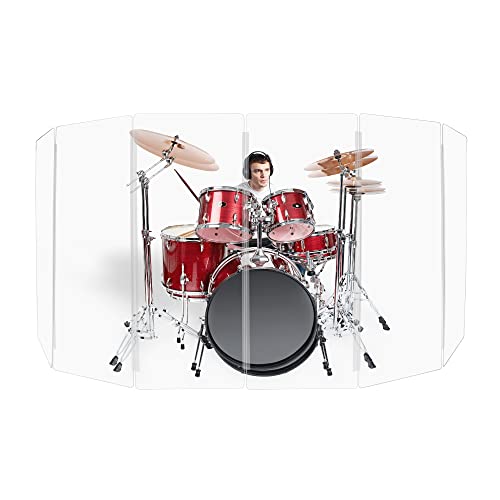
This is a popular drum shield on the market and there are several good reasons for that. First of all, this is a pretty basic shield. You won’t find any deflectors or similar things, just regular acrylic panels.
There are five of them, with a 5ft height, which ensures decent noise protection. Of course, it won’t lower the volume significantly but should be more than enough to ensure convenient performance for both bandmates and sound engineers.
The DS4 uses five clear 5-foot acrylic panels joined by chrome hinges. The panels give the engineer a line-of-sight barrier in front of the kit. Allow room to angle them around your cymbals and stands; the shield itself does not absorb sound like a treated booth.
2. Pennzoni Drum Shield DS1
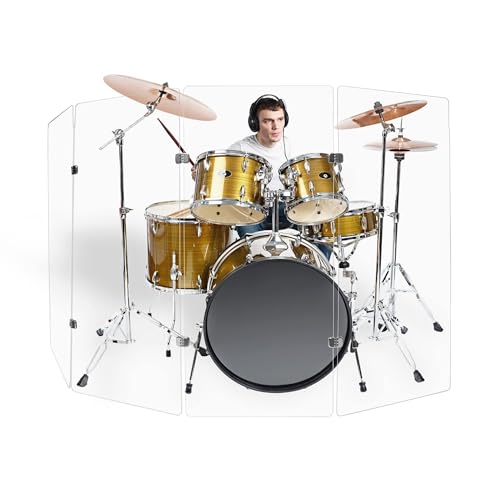
The Pennzoni DS1 uses four shorter acrylic panels, which is useful where sight lines and a smaller footprint matter. It is a partial front screen, so expect less separation than a taller shield or a treated enclosure. Check its 4-foot height against your cymbals before ordering.
The clear panels preserve a view across the stage and use chrome hinges to connect the four sections. This smaller shield can be easier to move and set up than a full enclosure, though it leaves more of the upper kit exposed.
The thing we like most about this shield is that it is compact and doesn’t require too much time to set up. Also, we like the price.
3. Clearsonic Isopac B Isolation Booth
For a drummer who needs more isolation than a front acrylic screen, the ClearSonic IsoPac B is the distinct option here. ClearSonic describes its current IPB package as a booth with acrylic panels, Sorber absorption, a lid and a fan, and estimates a 50–60% perceived-volume reduction for its configuration.
The DS4 is a practical front barrier when drum spill into nearby microphones is the main issue. Its effectiveness depends on where the kit, microphones and room reflections sit, so plan acoustic treatment if reflected sound remains a problem.
The IsoPac B needs a footprint of about 6 feet by 7 feet and stands about 6.5 feet tall. That is compact for a treated booth but still requires a measured stage or studio space. Its rear ventilation gap also means it is not airtight or completely soundproof.

The DS7D listing specifies six 6-foot clear panels with plastic hinges and deflectors. Choose this height when the upper kit needs a taller front barrier; its wider spread needs more floor space and careful placement around microphones.
The deflectors add coverage above the main panels. They can help direct cymbal spill away from nearby microphones, but the result depends on the room and setup rather than a guaranteed reduction figure.
Despite a large number of parts, this set is quite simple and easy to install, so it won’t take too much time to set up. The price might seem high to some, but keep in mind that noise protection is amazing.
5. Pennzoni DS5 L Six-Panel Drum Shield
Pennzoni DS5 L Drum Shield gives you six 5-foot panels without deflectors. The wider coverage and flexible plastic hinges distinguish it from the five-panel DS4 above.
The current exact listing is DS5 L: each of the six clear acrylic panels is 2 feet wide and 5 feet tall. This is a front screen rather than a sealed enclosure, so leave space for stands and consider room reflections when positioning it.
With no deflectors, the DS5 L is simpler to position than the taller DS7D. It suits a kit that needs more width than the DS4 while keeping the top of the screen at 5 feet.

Compact in size but very useful. DS5D shield isn’t as tall as most shields that come with deflectors.
It features 2ft. x 4ft. panels, which makes it compact and transport-friendly. Six panels are attached with chrome hinges, though you can opt for living hinges as well.
Its six 4-foot panels make a lower screen, while the included deflectors add upper coverage. Check your seated sight line and the cymbal heights before choosing this version over a plain 5-foot shield.
Pros and Cons of Drum Shields

A clear front shield can reduce direct drum spill toward performers and microphones in front of the kit. It also reflects sound back toward the drummer, so it should be placed with the stage layout and microphone positions in mind.
This allows other musicians on stage to play conveniently. Singers will finally hear themselves, while other musicians will be able to use in-ear monitors with ease.
Besides your bandmates, another person who will feel great relief is a sound engineer. Live mixing is one of the hardest things to do if drums are too loud. It’s not a rare thing to hear drums on a singer’s or other musician’s microphone and it seems impossible to deal with that unwanted noise in a proper way.
Thanks to drum shields, sound engineers can count on a cleaner signal from each microphone, which allows each instrument to be compressed differently, as well as different EQ settings.
Of course, there are a couple of drawbacks as well. The first thing that comes to mind is the fact that too much noise will remain inside the shield. As the sound bounces inside the shield, you will probably need protection or in-ear monitors at least.
Another big issue is the setup time. Drummers already need a lot of time to set up and tune a drumset before the show, so setting up a drum shield would require even more. Also, this means transport issues, so make sure that the shield you want to buy is compact when packed.
Finally, a close screen or booth may feel restrictive. Keep a safe exit path and plan monitoring and ventilation before using a full enclosure.
Types of Drum Shields
There are three main types of drum shields. Those would be full coverage, full front, and partial front.
A full enclosure combines barriers with absorption around and above the kit. Its results depend on the particular booth and room; ClearSonic describes its IsoPac B as a partially open, ventilated design with a claimed reduction in perceived volume, not complete isolation.
Full-front drum shields are the most common type you can find on the market. As you may presume, these panels are positioned in front of the drum kit, lowering the volume on stage.
Partial front shields feature a similar design to full-front drum shields, but these are lower. Practically, panels are tall enough to reduce the noise of most drum parts.
On the other side, these shields allow the drummer to have a better view of the stage and better communication with other musicians on the stage. Of course, these shields have the lowest percentage of noise reduction.
DIY Drum Shields?

As you’ve probably noticed, most drum shields come from the same manufacturer. There aren’t many drum shield makers around and the reason lies in the fact that many drummers prefer custom-made shields.
Simply, everyone wants a shield that perfectly fits his drum set. Therefore, there is no reason why you shouldn’t do the same.
Of course, this would require decent craftsmanship skills. Still, keep in mind that you probably won’t save too much money, considering that acrylic (plexiglass) panels are usually quite expensive.
Therefore, if money savings are your motive, you probably won’t have too much luck. On the other side, if you want to build a shield that perfectly meets your demands, there is no better thing than to make it yourself.
Conclusion
Drum shields help manage spill in live and recording setups, but they do not replace hearing protection. Reflections can make it loud inside a screen or booth, so the drummer still needs appropriate ear protection or a carefully set in-ear mix.
My top recommended drum shield is the Drum Shield DS4 as a good overall drum shield at a reasonable price that will get the job done.
My second recommended drum shield is the Pennzoni Drum Shield DS1 which is a budget-friendly option for those looking for something more affordable.
While a drum shield serves many purposes, there are a couple of downsides. These panels will take a long time to set up, may be too claustrophobic for some drummers and their big size can create other problems. Nevertheless, they are useful additions to most drummers.