
The 5 Best Steel Tongue Drums (2026)

A steel tongue drum is a fantastic instrument to play. This musical instrument is both elegant and playable, appealing to all sorts of musicians. They aren’t as complicated to play as hang drums.
Steel tongue drums resonate with amazing sounds that leave most people in awe.
My top pick is the Yinama Steel Tongue Drum, it has a well-rounded base and comes at a very affordable price.
My budget pick is the Meinl Sonic Energy SSTD1BK. It is a compact option for casual playing, with a bag and mallets included.
Contents
- The 5 Best Steel Tongue Drums (2026)
- 1. Yinama Steel Tongue Drum
- 2. Meinl Sonic Energy SSTD1BK
- 3. Thomann Tongue Drum 13" Lotus G
- 4. Meinl Sonic Energy MOSTD4DG
- 5. GUDA DRUM Freezbee
- What is a Steel Tongue Drum used for?
- How does a Steel Tongue Drum work?
- What does a Steel Tongue Drum Sound like?
- What is a Reasonable Price for a Steel Tongue Drum?
- What is the Difference Between a Steel Tongue Drum and a hang drum?
- What to look for in a Steel Tongue Drum when Buying one?
- How do you Tune a Steel Tongue Drum?
- How many Notes does a Beginner Need?
- Conclusion
The 5 Best Steel Tongue Drums (2026)

And now onto the full list:

1. Yinama Steel Tongue Drum
The Yinama Steel Tongue Drum is the top pick for many reasons. While offering the sweet middle-ground which is 11 notes and 12 inches in diameter, it has a durable structure due to the high-quality steel that produces amazing sounds through beautiful resonance and vibration.
Pros
- Excellent value-for-price ratio
- Perfect middle ground (11 notes, 12 inches)
- Durable drum with great sound quality
- 11-note layout for practicing melodies
Cons
- A little heavy for some
If you’re looking for a good value-for-price product, I doubt you will find a better choice than this one. The Yinama Steel Tongue Drum has many benefits with little to no issues. With amazing aesthetics, this drum is a durable and playable instrument that best suits students and teachers. The 11-note layout gives you more melodic options than the smallest pentatonic drums. The only drawback is that it might be a little heavy for some but that is definitely no deal-breaker here.
| Material: | Steel |
| Notes: | 11 notes |
| Size: | 12” |
As I mentioned before, there is a reason why the Yinama Steel Tongue Drum is my top pick. With so many benefits and little to no drawbacks, this steel tongue drum is the best all-around choice.

2. Meinl Sonic Energy SSTD1BK
The Meinl Sonic Energy SSTD1BK is my compact budget pick. Its seven-inch body is easy to keep on a desk or carry in the included bag. You get eight notes in F minor, so it suits free playing and simple patterns without needing a large instrument.
Pros
- Compact seven-inch body
- Eight-note F-minor scale
- Bag and rubber-headed mallets included
- Coated stainless-steel construction
Cons
- Limited notes for playing familiar songs
- Fixed scale, rather than user-selectable tuning
This is a useful first tongue drum if you want to explore the sound without making room for a full-size model. The notes are F4, Ab4, Bb4, C5, Eb5, F5, Ab5 and Bb5. That pentatonic selection is forgiving when you improvise, but it leaves out notes you might need for a particular melody. Check your song before choosing it for music lessons.
The small body keeps the portable role of the original budget pick. The included bag and mallets also make it a practical gift. It is larger than a miniature six-inch drum, while still fitting comfortably into a compact setup. Choose the Yinama or Lotus below if a wider selection of notes matters more than portability.
| Material: | Coated stainless steel |
| Notes: | 8 |
| Size: | 7 inches |
| Scale: | F minor, 440 Hz |
For casual playing and a small instrument to take along, the SSTD1BK is a sensible choice. Buy this exact black F-minor model if that is the tuning you want; other Meinl sizes and colors can use different scales.
3. Thomann Tongue Drum 13" Lotus G
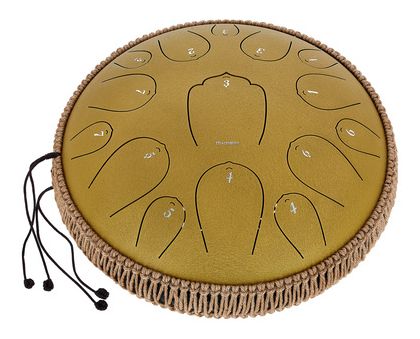
The Thomann Tongue Drum 13″ Lotus G is my wider-melody pick. Its fifteen notes cover a D-major diatonic scale, giving you more room for recognizable tunes than the smaller pentatonic drums. The gold finish and rope trim keep the decorative appeal of the original larger pick.
Pros
- Fifteen notes for a wider melody range
- D-major diatonic tuning
- Case, mallets, finger picks and note stickers included
- Steel body with a gold finish
Cons
- Larger body to transport
- Scale still limits which songs you can play
- Thomann buying option requires international delivery for US readers
The notes run from F# through G, A, B, C#, D and E, repeating up to a higher F#. A diatonic drum gives you more steps of the scale than a pentatonic model. That helps when learning a tune from a book, but it also means random combinations may clash more readily. Start slowly and use the number stickers to keep track of your melody.
This is a larger steel drum with a useful accessory set. The case and supplied mallets make it ready for practice, while finger picks give you another way to strike the tongues. At thirteen inches, it is better suited to a stable lap or table than a very small travel bag.
| Material: | Steel |
| Notes: | 15 |
| Size: | 13 inches |
| Scale: | D major diatonic |
| Finish: | Gold |
Choose the Lotus if you want to learn melodies and would rather have more notes than the smallest body. This is a Thomann house-brand instrument with a direct Thomann buying option. US readers should check delivery terms before ordering; the ten-inch and twelve-inch Lotus models are different products.

4. Meinl Sonic Energy MOSTD4DG
The Meinl Sonic Energy MOSTD4DG takes the meditation role a step further with octave tongues. Its eight F-sharp-minor notes produce a main pitch with an octave above it, which gives a layered sound without adding extra notes to learn. The ten-inch body is a useful middle size for playing on your lap.
Pros
- Octave tongues add depth to each note
- Eight-note F-sharp-minor layout
- Carrying bag and mallets included
- Silicone feet help keep it steady
Cons
- Fixed F-sharp-minor scale
- 432 Hz tuning needs care when playing with other instruments
This Meinl model suits beginners who want gentle sounds and a portable drum, with a specific octave sound that distinguishes it from the plain eleven-note Yinama. Its notes are F#3, A3, B3, C#4, D4, E4, F#4 and A4. It is a fixed instrument, so the extra octave vibration should not be confused with a second selectable scale.
A removable silicone plug lets you change how open the body sounds, and the supplied bag makes it easier to move between home and a class. Use the included mallets or your fingers and let the notes ring before adding another phrase. Relaxed playing is a good use for it, but an instrument should not be bought on promises that a particular tuning will heal a medical condition.
| Material: | Coated stainless steel |
| Notes: | 8 octave tongues |
| Size: | 10 inches |
| Scale: | F-sharp minor, 432 Hz |
| Finish: | Dark green |
The MOSTD4DG is my choice for a small octave drum. Its 432 Hz reference pitch differs from standard 440 Hz tuning, so check compatibility before using it alongside a keyboard, guitar or recorded accompaniment.
5. GUDA DRUM Freezbee
The GUDA DRUM Freezbee is definitely a one-of-a-kind steel tongue drum with its amazing design and finish. This drum is premium quality for a reason and you can see that just by looking at it. Suitable for all types of music aficionados.
Pros
- Beautiful handcrafted design
- Widely applicable
- Comes with great packaging
Cons
- Limited to its chosen eight-note scale
- Premium choice for a first instrument
The Freezbee uses hard stainless steel and weighs about two kilograms. Its light body makes it easier to carry, rather than being a drawback. Choose it for the engraved design and its particular eight-note voice; a less expensive drum may be enough if you are simply trying out the instrument.
The GUDA DRUM Freezbee is an incredibly appealing drum that is widely applicable to any situation or activity, or even as a decoration (for those that have the budget). As far as sound, this drum has a very good-sounding base with an eight-note layout. Check the exact listing’s scale before ordering. Custom scales are a separate maker order, rather than a choice built into the linked Amazon offer.
| Material: | Steel |
| Weight: | About 2 kg |
| Notes: | 8 notes |
| Size: | 35 cm (about 14 inches) |
The GUDA DRUM Freezbee is a hybrid mix of a handpan drum and steel tongue drum with top-of-the-shelf aesthetics and offers a good sound.
What is a Steel Tongue Drum used for?
The steel tongue drum is part of the idiophone family because it creates the sound without the need for additional resonators, strings, or other similar components. Tongue drums are often used for relaxation, improvising simple melodies and music education.
The steel tongue drum resonates with beautiful sounds that many people enjoy during relaxation and meditation. Most people also use it for music therapy or music education. Because of the beautiful-sounding nature of this drum, it’s widely used by many across the globe.
How does a Steel Tongue Drum work?
As mentioned earlier, the steel tongue drum is part of the idiophone family of instruments. It has a variety of cut-out tongues in different sizes. Since the tongues are constructed in a variety of sizes, they generate distinct frequencies, which is how different notes are produced. The sounds that come from this instrument are simply breathtaking and the good thing is, it’s really easy to learn and play this drum.

What does a Steel Tongue Drum Sound like?
Steel tongue drums can be played with mallets or fingers and come in many scales, including major, minor and pentatonic tunings. Most notably, the sound of the steel tongue drum has a noticeable long sustain compared to other instruments. It produces a very melodic and soothing sound, hence why it’s widely used for meditation and relaxation.
Many words come to mind as to how to describe the sound of the steel tongue drum: calming, beautiful, melodic, ambient, ethereal. But I think the most appropriate word is soothing. This instrument provides relaxing sounds that can be enjoyed by anyone regardless of age.
What is a Reasonable Price for a Steel Tongue Drum?
The cost of a steel tongue drum depends on its size, construction and features. Lower priced ones will generally get you a basic tongue drum, whereas premium tongue drums are often much better put-together, have a better sound, and may have other features (such as a built-in microphone or tunability).
The list above includes compact beginner drums, a wider-range melody instrument and more specialized octave and handmade options. Most steel tongue drums come with their own set of accessories like drum mallets, drumsticks, fingerpicks, note stickers, and even a travel bag.
What is the Difference Between a Steel Tongue Drum and a hang drum?
Steel tongue drums are generally smaller, cheaper, and don’t have as rich a sound as hang drums or hand pans.
You might already know the hang drum or hand pans which are percussion instruments. These come up a lot when on the topic of steel tongue drums and the reason is that they are very similar in a few ways.
First of all, the steel tongue drum is way more economical than the hang drum. Secondly, hand pans are larger instruments compared to the tongue drum and produce a more percussive sound. Lastly, their looks might be the reason behind the comparisons because they resemble each other in a way, but nevertheless, they are different instruments.
What to look for in a Steel Tongue Drum when Buying one?
I think the first obvious thing is to consider the price of the instrument. Taking time to evaluate and figure out your price range before purchasing an item like this is always a good choice. A basic model may be enough for casual playing, while octave tongues, handmade decoration or adjustable scales call for a different choice.
The other thing to consider is the quality of the product. Most steel tongue drums, while having similar prices, are not made from the same durable material. You can locate a strong product, like a well-made steel tongue drum, to match the description.
Another key feature to keep in mind is the notes. Look for a steel tongue drum around the perfect middle ground which is 8/10 notes. These steel tongue drums offer good versatility in sound while not incredibly expensive. You can find affordable ones with notes that will suffice for you.
Size and weight are the last things. If you are looking for a portable option then search for ones that are lightweight products and can be easily transported. If you want a more heavy and durable one, then you can also find a steel tongue drum that is not so portable but offers great quality and sound. Luckily this list has them all.
Do not judge a drum by diameter alone. A small eight-note model can be a good fit for improvising on the sofa, while an eleven-note or fifteen-note drum may be more useful for learning songs. More notes do not make every instrument easier to play. A pentatonic layout omits some of the steps of a full major or minor scale, which can help a beginner find pleasant combinations without following a melody book.
For a portable drum, look at the body size, weight and included bag together. The seven-inch Meinl fills the compact role here and includes a bag, so it is worth considering if you want a small instrument to take along. A larger drum gives your hands more room around the tongues. If you want to play on your lap, check that you can support it comfortably and reach each note without covering another tongue.
A recognizable maker and an attractive finish can matter as much as the largest note count. A drum with fewer notes is not automatically worse; it may simply suit a different playing style. For example, the octave Meinl and handmade Freezbee offer different voices from the wider-range Lotus. Listen to the exact model and scale before choosing: a sound sample from another tuning or a larger version may give the wrong impression.
How do you Tune a Steel Tongue Drum?
Most Steel Tongue Drums are tuned to a specific scale. Many are tuned to the C major pentatonic scale, but there are plenty of tongue drums use alternative scales. Some also have tunability, which allows you to make some adjustments (but often just a semitone or so, therefore you can’t tune these like a guitar for example!). Some offer a custom pitch preference when ordering (such as 432hz)
Some models designed for adjustable tuning use magnets beneath the tongues. Moving the supplied weights changes their pitch. Follow that model’s instructions and use a chromatic tuner; ordinary fixed-scale drums should not be treated as adjustable instruments.
Do not heat, bend or file a fixed-scale drum to change its tuning. That can damage the instrument. Ask the maker about a note that seems out of tune before attempting a repair.
If you want to change scales, choose a drum expressly designed for magnetic tuning. It can be useful when writing different pieces or matching another instrument, but you will need to learn the adjustment process. A fixed-scale drum is simpler to start with: choose its key and note range before ordering, rather than expecting to retune it like a guitar.
An integrated pickup is another feature to consider for busking, recording or playing with a band. A suitable output can connect to an amplifier or audio interface. It does not mean that headphones will work directly from the drum, and the instrument can still be played acoustically. Check whether the exact version you are buying includes the pickup; an acoustic version and an electro-acoustic version are different offers.
Standard 440 Hz tuning is the easier starting point when playing alongside other instruments. A 432 Hz model can be enjoyable on its own, but it may clash with a fixed-pitch 440 Hz keyboard or recording. Pick the tuning for the music you plan to make, rather than assuming that one reference pitch has proven health benefits.
How many Notes does a Beginner Need?
A beginner should opt for 8 to 10 notes when getting a steel tongue drum. This is the sweet spot for almost anything regarding the steel tongue drums. A six-note pentatonic drum can also be enough for simple improvisation, though it leaves out more notes for familiar songs. As you progress, a model with eleven or fifteen notes can offer more options for melodies, provided that its scale suits the music you want to play.
Conclusion
Steel Tongue Drums were first introduced in 2007 by Dennis Havlena. They are amazing and beautiful-sounding instruments. They are also very versatile and can be played in a multitude of scenarios.
Steel tongue drums are often used for creating gentle, heart-opening sounds that can be used in meditation or yoga. They also include a nice and wide range of notes. While 8 to 10 notes tend to be the preferred choice, beginners can also explore different options with 6 notes. Choose the note layout that fits the music you want to play.
My main recommended product is the Yinama Steel Tongue Drum which offers a well-rounded quality regarding sound and build structure, suitable for most anyone. My second recommended product is the Meinl Sonic Energy SSTD1BK for those on a tighter budget looking for a good quality steel tongue drum.




