
The 7 Best Electronic Drum Amps and Monitors (2026)
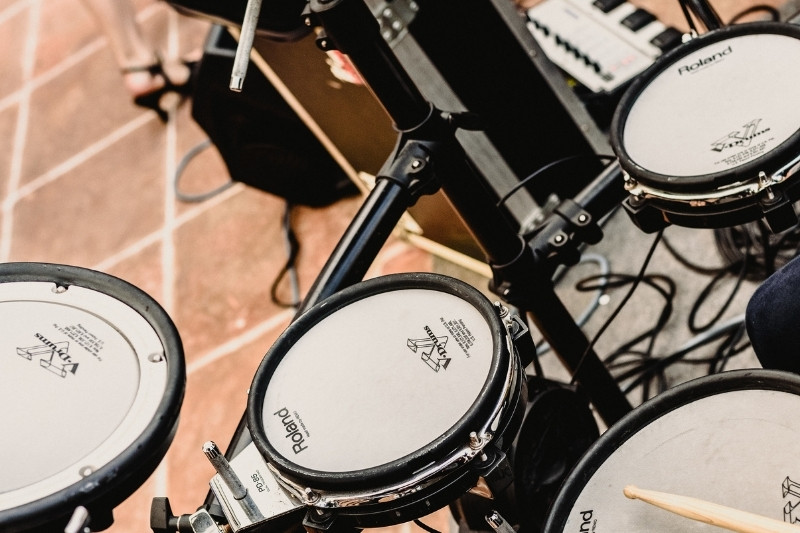
Electronic drum sets are a lot more fun when you have a good drum amplifier. Amplifiers are used as speakers for practicing or for smaller gigs. They can also be used as personal drum monitors while gigging.
A good amplifier or monitor should be able to amplify both low-frequency and high-pitched sounds while keeping the music clear and crisp.
Set either speakers or headphones to a comfortable listening level. A monitor is useful when you want to hear the kit in the room or share practice with another musician.
Note: keyboard amps are also generally well-suited for electronic drum sets.
My top recommended drum amp is the Roland PM-100. This is a pretty neat amp for home practice with enough power.
My second recommended drum amp is the Donner DDA-35. This is a high-quality yet affordable option.
Contents
- The 7 Best Electronic Drum Amps and Monitors (2026)
- 1. Roland PM-100
- 2. Donner DDA-35
- 3. Alesis Strike Amp 8 MK2
- 4. Roland PM-200
- 5. Simmons DA2108
- 6. HeadRush FRFR-108 MKII
- 7. Alesis Strike Amp 12 MK2
- What is an Electronic Drum Amp?
- Do you need an Electronic Drum Amp for your electronic drums?
- Can you use any type of Amp for an electronic drum kit?
- How much power do you need in an Electronic Drum Amp?
- How portable do you need your Electronic Drum Amp to be?
- What other features do you need in an Electronic Drum Amp?
- Do you need an Electronic Drum Amplifier to record your electronic drum set?
- Verdict
The 7 Best Electronic Drum Amps and Monitors (2026)

Let’s compare these in more detail.

1. Roland PM-100
The PM-100 is my first choice for a drummer who wants an uncomplicated speaker beside a home kit. Its dedicated V-Drums input and separate line-level volume make it easier to balance drums against a wired backing track without adding a mixer.
Roland specifies an 80-watt amplifier, a 10-inch woofer and a 2-inch tweeter. Bass and treble controls provide basic adjustment. The V-Drums input, quarter-inch line input and miniature line input are separate sockets, but the two line sockets share a volume control.
Choose it for personal monitoring, rather than buying on wattage alone. It has no headphone socket, Bluetooth or direct output: use the drum module for headphones, and choose the PM-200 if you need an XLR feed to a mixer.
| Amplifier | 80 watts |
| Speaker | 10-inch woofer; 2-inch tweeter |
| Connections | V-Drums input; quarter-inch and miniature line inputs |
| Trade-off | No direct output or headphone socket |
Pros
- Simple drum and backing-track controls
- Dedicated drum-monitor layout
Cons
- No XLR output
- No Bluetooth

2. Donner DDA-35
The DDA-35 is the budget choice for quiet home practice. It replaces the old Coolmusic recommendation because that listing now identifies a Vangoa 65-watt product, while the original recommendation described Coolmusic’s 100-watt DM100. Those are not interchangeable specifications.
Donner specifies a 35-watt amp, an 8-inch woofer and a 2.5-inch tweeter. Two input channels, three-band EQ and Bluetooth cover a straightforward practice setup. Its headphone output is particularly useful when you want to keep the speaker muted, while the DI output provides a connection to other audio equipment.
I would buy it for a small practice room, not as a promise of competing with a loud acoustic band. Set backing-track and drum levels conservatively; a compact speaker has limited room for heavy kick sounds. The offer is the black standalone DDA-35, not a drum-kit, throne or power-adapter bundle.
| Amplifier | 35 watts, manufacturer specification |
| Speaker | 8-inch woofer; 2.5-inch tweeter |
| Practice features | Bluetooth; headphones; three-band EQ |
| Buyer role | Small-room home practice |
Pros
- Headphone option
- Useful basic tone controls
Cons
- Small cabinet limits bass headroom
- Not a band-volume guarantee

3. Alesis Strike Amp 8 MK2
The Strike Amp 8 MK2 suits a drummer who wants a small powered monitor with more routing flexibility than a basic practice amp. Two XLR/quarter-inch combo inputs have independent level controls; Bluetooth adds a convenient backing-track source.
The MK2 has an 8-inch woofer, an XLR mix output, a high-pass switch and a ground-lift switch. Use the high-pass filter when low-frequency buildup makes the monitor boomy; it is not a bass-boost button. Ground lift addresses some connection hum, rather than improving tone.
The advertised 2000-watt figure is peak power and should not be compared directly with Roland’s amplifier ratings. I prefer this model where compact transport matters, but its small woofer remains a compromise for sustained low kick sounds. A second cabinet or PA connection can be more useful than turning one monitor to its limit.
| Woofer | 8 inches |
| Advertised power | 2000 watts peak |
| Inputs | Two combo inputs; Bluetooth |
| Output | XLR mix output |
Pros
- Compact powered-monitor format
- Independent input levels and XLR output
Cons
- Peak watts do not establish usable loudness
- No headphone output
4. Roland PM-200
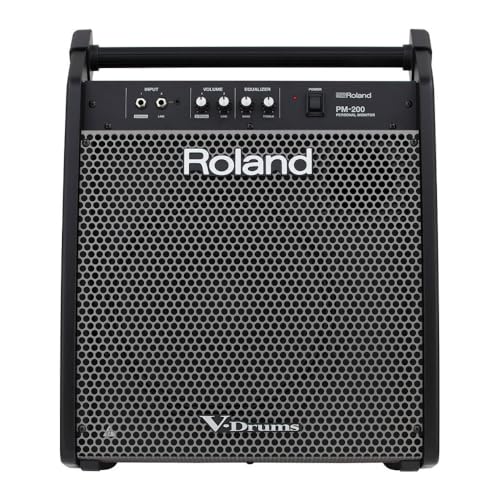
The PM-200 earns its place for drummers who want a dedicated drum monitor and a practical feed to the front-of-house mixer. Its two XLR direct outputs are the main reason I would choose it over the PM-100, rather than assuming the models have identical connections.
Roland specifies 180 watts, a 12-inch woofer and a horn tweeter. Separate V-Drums and line controls, plus bass and treble EQ, keep the panel familiar. The cabinet plays in mono; the direct-output switch can preserve a stereo V-Drums input feed for external equipment.
This is the dedicated stage-oriented choice in the list, though it is heavier than the PM-100 and has no Bluetooth or headphone socket. Check your module’s output wiring before connecting it: sending only one side of a stereo signal may omit panned sounds.
| Amplifier | 180 watts |
| Speaker | 12-inch woofer; horn tweeter |
| Direct outputs | Two XLR sockets |
| Cabinet playback | Mono |
Pros
- Useful direct outputs for a mixer
- Straightforward drum-monitor controls
Cons
- Heavier than PM-100
- No wireless backing-track input

5. Simmons DA2108
The Simmons DA2108 replaces the KAT KA1 as the portable practice pick. The KA1 remains documented by its manufacturer, but I could not verify a current new-unit offer through the checked destinations. That buying-path problem is different from proving the model discontinued.
Simmons specifies 100 watts RMS and 400 watts peak, an 8-inch woofer and a 1-inch compression driver. Bluetooth, left/right quarter-inch inputs and an auxiliary input support drums and music playback. A headphone connection mutes the speaker, and XLR direct/link outputs help connect a mixer or another monitor.
For my practice-focused reader, having headphones and external routing in one portable cabinet is more useful than chasing a peak-power number. The two-knob EQ offers quick adjustment but less detailed control than a mixer. Try the cabinet’s position before increasing bass: nearby walls can change what you hear.
| Power | 100 watts RMS; 400 watts peak |
| Speaker | 8-inch woofer; 1-inch compression driver |
| Practice | Bluetooth and muting headphone output |
| Routing | XLR direct and link outputs |
Pros
- Headphones and speaker practice in one unit
- Portable cabinet with external routing
Cons
- Two-band EQ has limited detail
- Small woofer remains a bass compromise

6. HeadRush FRFR-108 MKII
The FRFR-108 MKII replaces the ddrum DDA50BT as a compact monitor with a verified current buying path. It is designed for amp modelers, but its full-range powered-speaker layout also makes sense for an electronic drum module’s line output. This recommendation is about flexible monitoring, not adding a guitar amplifier’s coloration to drums.
HeadRush specifies an 8-inch woofer, two combo inputs, Bluetooth playback and an XLR output. Its advertised 2000 watts is peak power. The high-pass switch reduces low-frequency energy; leave it disengaged if it removes too much of the kick sound you need.
I would choose it for a shared music room where the same cabinet handles drums and other line-level gear. It has no headphone output or multi-band front-panel EQ, so keep those jobs at the module or mixer. The MKII offer is distinct from the original FRFR-108 and larger FRFR-112.
| Format | Full-range powered monitor |
| Woofer | 8 inches |
| Inputs | Two combo sockets; Bluetooth |
| Controls | High-pass filter; ground lift |
Pros
- Useful across several instruments
- Compact cabinet and XLR output
Cons
- Not specifically a dedicated drum amp
- No headphones or multi-band EQ
7. Alesis Strike Amp 12 MK2
The Strike Amp 12 MK2 is the larger powered-monitor option. Its 12-inch woofer gives you a different cabinet choice from the 8 MK2; I would select it when transport space matters less than having a larger speaker beside the kit.
The exact MK2 offers identify Bluetooth, two independently controlled combo inputs, an XLR output and high-pass/ground-lift switches. The advertised 2500 watts is peak power. Those numbers alone do not demonstrate that it will overpower a band or reproduce every low-frequency sound at maximum volume.
Compared with the PM-200, this is the choice for players who prefer the flexible input layout of a powered PA-style monitor. Compared with the 8 MK2, the decision is cabinet size and portability, rather than a guarantee of better sound in every room. Start with the module’s output below clipping and raise speaker level gradually.
| Woofer | 12 inches |
| Advertised power | 2500 watts peak |
| Inputs | Two combo sockets; Bluetooth |
| Routing | XLR output |
Pros
- Larger cabinet option
- Flexible inputs and output
Cons
- Bulkier than an 8-inch monitor
- No headphone output
What is an Electronic Drum Amp?
An electronic drum amp is an amplifier specifically designed so that you can hear the output from an electronic drum set.
Electronic drum amplifiers are not the only way that you can monitor your electronic drum set. You can also alternatively use electronic drum headphones.
If you don’t have an amplifier or headphones then you will not be able to hear anything coming out of the electronic drum set. Other than this, there will not be any noise out of it apart from tapping sounds when hitting the pads!
Do you need an Electronic Drum Amp for your electronic drums?
A speaker lets you hear the kit in the room and share it with other musicians. Headphones make more sense when you need to limit room noise. Choose according to your practice setting.
Keep either option at a comfortable level, and take breaks during long practice sessions.
Can you use any type of Amp for an electronic drum kit?
A powered full-range speaker or suitable keyboard amp is usually a more sensible starting point than a guitar amp designed to color the sound. Check that the input accepts your electronic drum module’s line output, and set the gain below clipping.
Also, many different types of PA speakers will tend to work quite well with electronic drum kits. A wide range of amplifiers will technically work with electronic drum sets, however, you may not get a desirable sound quality from them. Also, if you hook up an electronic drum set to a very low-powered speaker you may cause damage to it if you overpower it.
You need an amplifier that has a pretty dynamic range and one that will be able to output a reasonably wide range of frequencies. For example, low-end frequencies will be important for outputting sounds such as the bass drum and floor tom, whereas the high-end frequencies will be more important for at least a portion of the sounds coming from hi-hats, snare drums, and cymbals.
How much power do you need in an Electronic Drum Amp?
There is no universal wattage requirement. The room, speaker size, playing level and other instruments all affect the monitor you need. A modest practice amp can suit home use; a loud band may require a larger monitor or the PA.
Compare continuous and peak ratings carefully. A large advertised peak figure does not establish how loud or cleanly a speaker will play. Prioritize the cabinet, useful connections and a comfortable amount of headroom. Set the module and speaker levels so neither clips; reduce the level if the sound becomes distorted.
How portable do you need your Electronic Drum Amp to be?
If you are the kind of person who enjoys taking your electronic drum set on the road for gigging or band practice then I would recommend that you get a relatively portable amp because transporting them can sometimes be a bit awkward if they are too large.
However, it’s often a trade-off because you do not want to get an amplifier that is too underpowered and therefore will not suit its purpose.
What other features do you need in an Electronic Drum Amp?
Consider Bluetooth or an auxiliary input for backing tracks, headphones for private practice, and direct outputs if you will connect a mixer. Those connections can matter more than onboard effects, particularly when your module already provides EQ.
Do you need an Electronic Drum Amplifier to record your electronic drum set?
You do not need an amplifier to record electronic drums. You can simply record the sound coming out of your drum module directly via an audio interface on your computer, or you can use a USB connection to record the audio if your drum module already supports this.
I’ve read a few articles online over the last few years that state you need an amplifier to record electronic drums and that is completely untrue. Whoever wrote this has likely never even attempted to record an e-drum set!
Verdict
For home practice, I would start with the Roland PM-100. The Donner DDA-35 suits a smaller budget and adds headphones. Choose the PM-200 for its direct outputs, or a Strike MK2 for powered-monitor routing. Judge the cabinet, connections and room first; peak watts are a poor shortcut for choosing a drum speaker.




I own an alesis crimson 2 electronic drum kit. Will I be able to use it with the roland pm 200 drum monitor. Will it give me a clear punchy sound as I’m a rock drummer? Thanks. Andy.
Hi Andy, yes this will work nicely. For connecting, just connect the L/R outputs on the crimson module to the inputs on the Roland amp using standard 1/4 inch instrument cables. It’s a great electronic drum amp… You can tweak the sound a bit with the basic EQ knobs, e.g. increasing the Bass for bigger punch.