A good room mic captures the sound of your whole drum kit and the space around it. The right choice depends on your room and whether you want natural ambience or a room track to compress heavily.
My top recommended room mic for drums is the Audio-Technica AT4050. Its three pickup patterns make it a flexible choice for different rooms and mic positions.
My second recommended room mic is the Royer R-10, a ribbon option for a room track with less emphasis on the cymbals’ top end. For an inexpensive mono track to compress heavily, I recommend the Shure SM57.
Contents
The 6 Best Room Mics for Drums (2026)

1. Audio-Technica AT4050
The AT4050 is a sensible place to start when you want one microphone that can adapt to different rooms. It is a large-diaphragm condenser with cardioid, omnidirectional, and figure-8 patterns, plus a 10 dB pad and an 80 Hz high-pass filter. Those controls are useful because room-mic placement often changes between sessions.
Try cardioid facing the kit for a relatively direct picture, then compare omni from the same position to hear more of the space. Figure-8 offers another option: its side nulls can help you reduce a troublesome reflection or another instrument, provided you also account for what is behind the mic. Record a short passage at each setting and listen alongside the overheads.
The supplied shock mount is helpful on a floor that carries kick-pedal vibration. Leave the high-pass filter off initially if you want the room channel to contribute kick and floor-tom body; engage it when low-frequency rumble is the problem. My recommendation here is about flexibility. You still need to find a position where the cymbals, snare, and bass drum sit together naturally, and the AT4050 needs a preamp supplying 48 V phantom power.
Pros
- Three patterns for different room positions
- Pad and low-cut filter on the microphone
- Shock mount included
Cons
- Needs an input with 48 V phantom power
| Type | Large-diaphragm condenser |
| Polar patterns | Cardioid, omnidirectional, figure-8 |
| Controls | 10 dB pad; 80 Hz high-pass filter |
| Power | 48 V phantom power |
2. Royer R-10
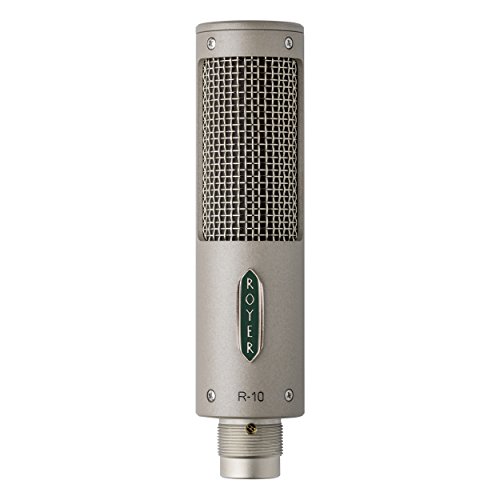
The Royer R-10 is the ribbon option I would consider for a room track with less emphasis on the very top of the cymbal sound. Royer specifies a 30 Hz–15 kHz response within ±3 dB and explicitly includes drum room miking among its applications. It is a passive mono ribbon with a figure-8 pattern.
That pattern hears the front and rear of the microphone while rejecting sound at the sides. Put some thought into the rear lobe: pointing it toward an unpleasant nearby wall can undermine the placement. Rotating the mic can be more useful than immediately reaching for EQ, particularly when a side null can face a reflective surface.
A single R-10 a few feet in front of the kit is a practical starting point for a compressed rock room track. Move it to balance shell weight against cymbal wash before adding compression. A quieter or more distant recording needs sufficient clean preamp gain, so check that part of your setup before buying.
The R-10 has an internally shock-mounted ribbon and a protective windscreen system, but it still deserves careful handling. Keep it away from strong air blasts and follow Royer’s connection instructions. Its high SPL capability is frequency-dependent; a headline rating at 1 kHz does not mean every placement is equally safe.
Pros
- Useful ribbon choice for drum ambience
- Side rejection gives another placement tool
- Internal shock mounting
Cons
- Can pick up unwanted sound from behind the mic
- Needs plenty of clean gain for quiet, distant recordings
| Type | Passive mono ribbon |
| Polar pattern | Figure-8 |
| Frequency response | 30 Hz–15 kHz, ±3 dB |
| Ribbon mounting | Internally shock-mounted transducer |

3. LEWITT LCT 441 FLEX
The LCT 441 FLEX gives you eight polar patterns in a compact condenser. Its selection includes omni, wide cardioid, cardioid, supercardioid, figure-8, and three reversed directional patterns. That makes it a useful purchase for a drummer learning how pickup direction changes a room recording.
Wide cardioid is worth trying when standard cardioid feels too focused on the front of the kit, but omni brings in too much of the rest of the room. The reversed patterns change which side of the capsule is the main recording direction. They can simplify a placement where the stand and microphone controls are awkward to reach. They do not reverse the timing of the recording or remove reflections.
LEWITT includes a shock mount, magnetic pop filter, windscreen, and transport bag. The shock mount has more relevance to this job than the pop filter, though the additional accessories also suit vocal recording. It runs on 48 V phantom power.
There is no onboard pad or low-cut switch. For a loud kit or a position closer to the drums, watch the microphone and preamp limits separately. A preamp pad protects its input stage but cannot undo distortion already produced inside a microphone. Choose the FLEX for its pattern choices and compact housing, with filtering available later in your recorder or DAW.
Pros
- Eight pickup patterns
- Wide cardioid and reversed patterns broaden placement options
- Compact body with shock mount included
Cons
- No pad or low-cut switch
| Type | Large-diaphragm condenser |
| Polar patterns | Eight, including three reversed directional patterns |
| Power | 48 V phantom power |
| Included accessories | Shock mount, pop filter, windscreen, transport bag |

4. AKG C414 XLS
The C414 XLS is the option for a recording space where you want detailed control at the microphone. It has nine pattern settings, three attenuation levels, and low-cut choices at 40, 80, and 160 Hz. The XLS is the version to look for here; the C414 XLII is a separate model with different voicing.
The intermediate pattern settings let you make smaller changes between the main pickup shapes. That can help when you have found a promising position but want to adjust the balance of direct drums and reflected sound without moving the stand. Its overload warning also helps you notice peaks that would be easy to miss while watching the DAW from across the room.
The filter choices need restraint on a full-kit room channel. A 160 Hz low cut can remove useful weight from the bass drum and toms, even if it tidies the track when heard alone. Try the lowest setting that solves the actual problem, then evaluate the full drum mix.
AKG also sells a matched-pair package for stereo recording. The single-microphone version is enough for a mono room track. I would put the XLS on a shortlist for a studio that records varied instruments and needs these controls regularly; a simpler microphone is easier to justify when you only need occasional drum ambience.
Pros
- Nine pattern settings
- Multiple pads and low-cut settings
- Overload warning for brief peaks
Cons
- Pricey, especially as a stereo pair
| Type | Large-diaphragm condenser |
| Polar patterns | Nine settings |
| Attenuation | −6, −12, −18 dB |
| Bass-cut settings | 40, 80, 160 Hz |

5. RØDE NT2-A
The NT2-A is a useful home-studio choice when the same microphone will record drums, vocals, and other acoustic instruments. It offers cardioid, omni, and figure-8 patterns, selectable pads of −5 and −10 dB, and 40 or 80 Hz high-pass filtering. It requires 48 V phantom power.
For a first mono room recording, start with cardioid and the controls set flat. Find a position with a convincing whole-kit balance, then compare omni if the room sounds good. The switches are on the microphone body, so these changes are straightforward without navigating software or reaching around a rack.
The NT2-A weighs roughly 860 grams before adding its mount. Use a stand that can hold it securely at your intended boom extension. A microphone slowly drifting downward during a take changes the recording and can become a physical nuisance around a drum kit.
Check the listing contents when comparing sellers: the Studio Solution package commonly includes the SM6 shock mount and pop filter, but accessory bundles can vary. The microphone itself is the relevant model. Its low-noise design is useful for quiet instrumental work between drum sessions, though noise specifications alone offer little guidance on whether your room has a pleasant decay.
Pros
- Three patterns and useful pad/filter switches
- Suitable for sharing between room and vocal recording duties
- Controls are accessible on the mic
Cons
- Heavy at 860 g
| Type | Large-diaphragm condenser |
| Polar patterns | Cardioid, omnidirectional, figure-8 |
| Controls | −5/−10 dB pads; 40/80 Hz high-pass filter |
| Power | 48 V phantom power |

6. Shure SM57
The SM57 earns its place here as a mono character mic. It is a cardioid dynamic with a contoured 40 Hz–15 kHz frequency response, so I would buy it for a focused ambience layer that can take heavy processing. A broad, natural stereo room picture calls for a different approach.
Place it in front of the kit or try a position that hears more shells and less cymbal wash. Record a few snare hits and a full groove, then add compression in the DAW. Bringing this track up underneath the close mics can contribute sustain and movement without needing a second matching microphone or another stereo input pair.
It needs no phantom power, and the supplied clip keeps setup simple. There are no pattern, pad, or filter switches. Its lower output compared with many condensers matters more when the mic is far from a quietly played kit: enough clean preamp gain is useful, and heavy compression will bring up background noise too.
If you already own an SM57 for snare, borrow it for a room experiment before deciding what to buy. Hearing what an extra ambience track contributes will help you choose between a dedicated ribbon, a multipattern condenser, and another general-purpose dynamic.
Pros
- Accessible choice for a processed mono room track
- No phantom power requirement
- Can also serve as a snare or instrument mic
Cons
- Less top-end detail than the condenser options
| Type | Dynamic instrument microphone |
| Polar pattern | Cardioid |
| Frequency response | 40 Hz–15 kHz |
| Phantom power | Not required |
How to choose a room mic for drums
Listen to the room before choosing the pattern
Have someone play while you move around the room. Listen for a place where the kick has body, the snare decay is pleasant, and the cymbals avoid dominating everything. A corner may exaggerate low frequencies; a low ceiling can create an obvious short reflection. Move the microphone and adjust treatment before assuming another model will solve the problem.
Cardioid, omni, and figure-8 capture different balances of direct and reflected sound. Omni can be effective in a good room, but it also hears unwanted noise all around the mic. A figure-8 ribbon has useful side nulls and a rear lobe that needs attention. A tighter pattern still captures reflections arriving from its sensitive directions.
Choose mono or stereo based on the mix
One mono room mic needs one preamp channel and can sit firmly in the middle of the mix. It is a good first step for rock, demos, and smaller recording spaces. A stereo pair can communicate the size and width of a room, but it uses two inputs and needs careful placement and mono checks. Buying a pair makes more sense once you know the space contributes something worth capturing.
Check the complete recording chain
Allow for the stand, mount, cable, and another recording input. Condensers need phantom power; passive ribbons and dynamics can need more gain at a distance. Our guide to audio interfaces for recording drums covers the input count and connections. Keep room and overhead duties clear: overhead microphones commonly provide the main cymbal and whole-kit picture, while a room track adds a more distant perspective.
Room mic questions
How far should a room mic be from the drums?
A few feet in front of the kit is a useful starting point, then move farther away to hear more room. The right distance depends on the room dimensions, ceiling, playing volume, and the role of the track. Monitor a short recording with the close mics rather than judging the room mic alone.
Should I align the room mic with the close microphones?
The room signal arrives later because sound travels farther. That delay contributes to its sense of distance. Listen before moving it in the DAW: alignment changes the character and can affect the combined tone. A polarity switch is a separate tool; it inverts the waveform and does not correct every timing relationship.
Can a room mic help an electronic drum recording?
A mic near an unamplified electronic kit mostly records stick, pad, and pedal noise. For a clean electronic drum track, record the module’s audio outputs or MIDI. A room mic becomes relevant when you deliberately record the kit through speakers or combine electronic sounds with acoustic drums. Our drum recording guide explains the main recording routes.