How To Drum Like Danny Carey (6 Tips)
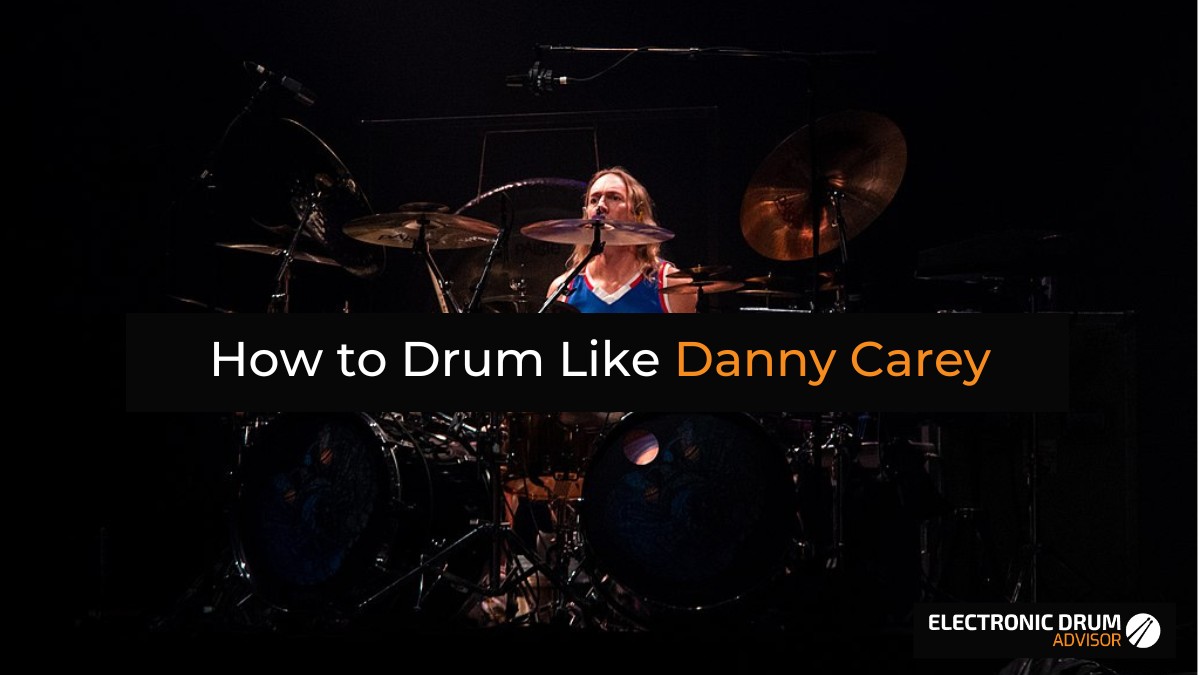
Formed in California in 1990, Tool is a progressive rock band known for its intricate approach to songwriting and critically-acclaimed albums. Their ambitious take on the prog sound has turned them into worldwide cult legends. Their songs are unique, mathematical, and very technically challenging, three traits that are best shown in the playing style of their revered drummer, Danny Carey.
Carey is universally regarded as one of the best drummers in the world right now. Drumeo listed him as one of the 100 best drummers of all time. Playing like Carey is not an easy task, but learning about his techniques, work ethic, musical approaches, and general mindset is the way to start.
Before taking a closer look into Carey’s drumming methods, check out five of the reasons why he is considered to be a musical genius:


Drumeo also has plenty of great notations and drumless tracks from the band Tool, and you can get access to them with this free 30-day trial of Drumeo. They also have some great lessons related to Danny Carey’s drumming and tips on how to play Tool songs.
Contents
1. Count like a pro: Danny Carey’s mathematical approach to drumming
Carey once stated that he wanted to be a professional basketball player. However, if he wasn’t a drumming god, he would probably make for a great mathematician. Much due to his drumming style, the discography of Tool reads like a complex equation, filled with odd time signatures, devastatingly convoluted polymeters, and demanding polyrhythms.
Carey’s mathematical approach to music can be heard and seen everywhere, even in the way he sets up his drum kit. While many top drummers are known to set up their kits symmetrically, Carey takes the concept to a whole another level, showing a quasi-obsessive perfectionism towards drum positioning.
Tool’s music goes heavy on the math! There is no lack of examples of complex odd time signatures in the groups discography, from the 5/8 and 7/8 interchanges in “Schism” to the incredibly challenging 7-over-3 polyrhythm of “Invincible.” In “Eulogy,” Carey plays a hi-hat pattern in groups of three over a steady 4/4 rock beat that takes a whole three bars to resolve—all while sounding incredibly groovy.
Carey is also a master of the polymeter, which refers to his ability to play in a different time signature than the time signature that the rest of the band is following. Still, Carey somehow never sounds out of place. Like an advanced mathematician, he is able to take on the most intricate formulas while still reaching a logical result everybody (and Tool’s fanbase in particular) can understand.
2. Make it happen: Danny Carey’s conceptual approach to drumming
Far from being just a “numbers guy,” Carey is known to be fascinated with spiritualism. While that doesn’t show directly in his drumming, it’s somewhat visible throughout Tool’s discography. His passion for the esoteric arts can also be associated with his conceptual approach to drumming, which takes on supernatural levels in tracks such as “Lateralus” and “Pneuma.”
In “Lateralus,” Carey moves through 9/8, 8/8 and 7/8 in the intro and choruses. Those individual meters are not successive numbers in the famous Fibonacci sequence; the title’s rhythmic and lyrical number connections are a separate idea. In a section of “Pneuma,” the phrase can be counted as 12/8, 11/8 and 10/8. Each step removes one eighth note, rather than one full dotted-quarter beat, and 12/8 is compound quadruple meter rather than an odd meter. Count a steady eighth-note subdivision and learn the phrase ending before adding the whole drum part.
While both examples can also be described as “mathematical,” that’s simply because all drumming can be put into numbers in the end. What these two tracks (and many others in Tool’s catalog) reveal is Carey’s disposition for conceptualizing his playing. The numerical ideas help shape the arrangement, but learning the actual accents and phrase lengths is more useful than treating every meter change as a Fibonacci calculation. Try singing the phrase first, mark where it repeats, then add a simple kick and snare pattern underneath.
Talking about his approach to composition in a 2012 interview, Carey stated “I never wanted just to play beats. I wanted to play the songs.” Serving the music instead of the instrument is a trait of many accomplished musicians, including the great late Neil Peart, but Carey takes this concept to another level. He’s not just playing the songs, but he’s playing actual ideas that go beyond the realms of music and sound.
3. Get the Danny Carey sound
Part of what makes every great drummer distinctive is their approach to sound. Carey’s drumming is recognizable not only because of his style of playing but also because of some of the sonic approaches he has taken on repeatedly over the years.
One of the best-known examples is his reliance on tom-based drum grooves. “Jambi” is but one of the many examples one can find in Tool’s discography. By using the toms as the driving sound in some of his best drum patterns, Carey somehow finds the freedom he needs to craft high-complexity rhythms that don’t lose on any of the catchiness.
Another characteristic Carey move is to play with the snare wires turned off, removing the wire buzz and giving the drum a more tom-like sound. It can still ring openly; switching the wires off is different from damping the head. “The Patient” is but one of the many tracks in which the great Tool drummer applies this technique. Try the same short groove with the wires off and on, keeping the head tuning unchanged so you can hear what the strainer alone changes.
As far as gear goes, Carey relies mainly on a Sonor SQ2 drum series drum kit.
4. Get inspiration from outside of your genre
It’s a capital sin of rock musicians: only listening to and relying on rock music influences. Part of what separates run-of-the-mill rock musicians from acclaimed rockstars such as Carey is the fact that the latter love going outside of their genre to find new, interesting ways of playing.
Carey has surely done this. In one of his Grammy Award acceptance speeches, he listed the great jazz drummer Tony Williams as one of his main influences. Other jazz greats who have inspired Carey include the likes of Billy Cobham, Lenny White, and, of course, buddy rich. In Tool’s catalog, Carey’s jazzy backbone is best shown by his ride-cymbal playing.
For inspiration, Carey has also looked outside of Western music. He reportedly studied tabla with the renowned Bengali tabla player Aloke Dutta and was sure to incorporate the instrument in his compositions. “Disposition” is perhaps one of the clearest example of tablas being used in a Tool song, but they’re all over the place! While Carey recorded the song using real tablas, he relies on his Mandala Pads to trigger his tabla sounds whenever he is performing in front of an audience.
5. Practice differently
Practice makes perfection, and practicing differently is the way to go to get unique results. Carey would probably agree, as he’s known to do something most drummers would never think of: practicing rudiments with his feet to improve his double-bass playing.
Carey has discussed parts of his practice and musical background in interviews, and his lower-limb rudiment tip gives us a useful starting point. His early percussion studies included snare drum, which is itself a drum rather than a separate stage before learning drums. That background supports the value of learning rudiments, but it does not by itself explain why he chooses tom-based grooves. Work on the sticking pattern first, then choose the kit sounds that fit your own phrase.
To get into the Danny-Carey mode, try to play rudiments using only your feet and incorporate new, original techniques into your drum practice. Start with slow alternating strokes on the two pedals, then try a paradiddle sticking with the feet: R L R R L R L L. Keep the doubles even and play a simple hand pulse over them only after the feet are controlled. This is a starting exercise, not a transcription of Carey’s private routine.
6. Let yourself go
All shreds of evidence seem to show that Carey is obsessed with numbers, perfection, and getting it right. However, the drummer of tool admitted in an interview that he doesn’t like to record or perform using a click track and that he feels that some of the musicians who do—including Judas Priest’s former drummer Dave Holland—end up sounding “weird.”
In his 2018 interview about playing live, Carey emphasized performing without a click and leaving room to react in the moment. That is a statement about his approach, rather than proof that no recorded or triggered sound has ever been used in any Tool performance. In the same interview, he stated that “You have to put yourself in this environment that’s vulnerable and go off in the moment.” That freedom sits alongside carefully composed parts; it does not mean losing the shared pulse.
Surprisingly enough, Carey is all about being natural, playing fluidly, and letting the tempo breathe with the band. In his 2024 interview with Rick Beato, he described agreeing on a tempo with a click before the count-in, then switching it off while the band played. For practice, alternate a short passage with and without a metronome, record it, and listen for an intentional change of energy versus an accidental rush. What’s ironic is that, beyond being very precise, his playing is what most (normal) drummers would describe as incredibly click-dependent. Nevertheless, it’s always a good idea to listen to the master and let yourself go!
Conclusion
The path to becoming a drumming genius sure ain’t easy, but you won’t get there unless you’re ready to learn from the best. Surely among the most talented drummers alive, Carey has some pretty interesting and unique approaches to drumming, composing, and practicing.

After interiorizing some of the concepts that make Carey’s playing so great and distinctive, it’s important to put them into action by trying to mimic some of his best-known grooves. Even doing that is no easy task but, luckily, there is plenty of high-quality content online that can help you on that journey.
The drummer’s website Drumeo is probably the best place to get familiar with Danny Carey, and they even have a few exclusive lessons featuring Tool’s music with drummer Aaron Edgar; check them out here.
Finally, check out this great Drumeo video on the “8 TOOL Songs You Always Wanted To Play On Drums,” which includes high-detailed instructions and sheet music on how to perform Tool tracks as popular as “The Grudge,” “Sober,” “Eulogy,” “Forty Six & 2,” and “Rosetta Stoned” on your favorite instrument:
Featured Image by: Selbymay, CC BY-SA 4.0, via Wikimedia Commons