Electronic Cajons have hit the music world with a bang, as they offer new sound possibilities while complementing the traditional sound of the Cajon. But, their acoustic qualities alone are not always adequate for all musical styles. This is where some great new electronic Cajon technology comes in.
I’m a big fan of Cajons. They are very popular instruments for street performances, playing small gigs, and as a primary choice for many different musical styles.
The Cajon is an extremely versatile and portable instrument. You can get a surprising variety of acoustic sounds from these little boxes.
Here are two ways to get Roland’s layered sounds. The EC-10 is a complete instrument, and the EC-10M adds sounds to a cajon you already play.
- The Roland EC-10 EL Cajon – This is a full electronic cajon instrument made by Roland. It works as an acoustic instrument with a great number of electronic additions ready to go.
- The Roland EL Cajon EC-10M Mic Processor – The mic processor is an option for you to adapt your current cajon into an electronic cajon.
The Cajon is a percussion instrument that originates from South America. The word Cajon literally means a box or a crate, which precisely describes the shape of this instrument.
It consists of four plywood sides and a hollow body. One of the sides is thinner, while the other three are a bit thicker. Every Cajon has a hole at the back, which gives Cajon players a chance to produce a variety of sounds.
The player is sitting on the Cajon while playing it. The playing patterns and the shape of this instrument haven’t changed for centuries. However, new electronic enhancements open up a whole new world of possibilities.
Contents
1. Roland’s Electronic Cajon – The EC-10 EL Cajon

The Roland EC-10 EL Cajon (EL stands for electronic layered) is a standalone instrument. For starters, it has a nicely manufactured body that produces very decent acoustic sounds even when played without electronic enhancements. However, the electronic elements sound amazing.
Have a look at this video to see this electronic Cajon in action:
The Roland EC-10 EL Cajon has a sound module built into its body. Separate sensors pick up strikes near the edge and on the head, so the layered sound can follow the way you already play.
Imagine a drummer who needs to switch from a tambourine to a shaker, djembe, or any other percussion instrument. With this electronic Cajon, you just choose the desired sound. There are 30 different kits integrated into this electronic Cajon.
Apart from the sounds produced by the player on the spot, the Roland EC-10 EL Cajon offers a variety of sound effects. This makes it a great choice for bands that play electronic music.
All the sounds and effects that you can create on this Roland Cajon are enhanced by electronic add-ons. This enables you to generate a vast number of sound combinations, which makes this instrument perfect for all sorts of live gigs and concerts.
The built-in speaker is handy for a small acoustic gig or street performance. For a bigger room, send the electronic layer from the Electronic Sound Out jack to the PA and let the sound engineer mic the acoustic cajon separately if it needs reinforcement. You can use an AC adapter or six AA batteries.
2. Roland EL Cajon EC-10M Mic Processor
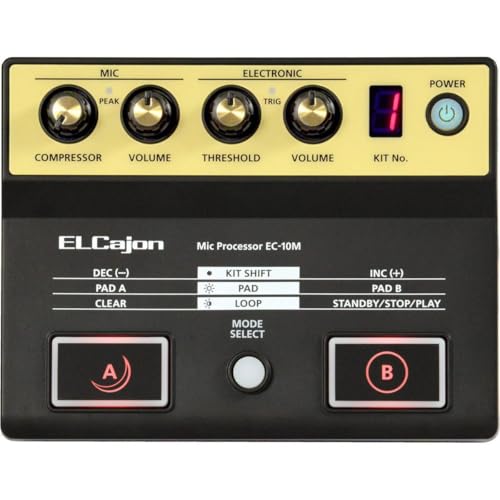
This mic processor from Roland is a great way of adding electronic enhancements to the acoustic Cajon you already own.
Using this processor will expand the number of playing options you have on the acoustic Cajon. The Roland Mic Processor offers 16 playing kits, which can raise the sound possibilities of your Cajon to a completely new level.
This video shows it in action really nicely:
This processor comes with an integrated looper. It’s a great feature for players who want to experiment with their Cajons and cover their sounds with various layers of innovative tones and sounds.
The included condenser microphone clips to the sound hole on the back of your cajon. Set the mic gain with your hardest strokes first, then bring up the electronic layer until it sits where you want it.
The A and B footpads trigger two extra sounds from the selected kit while your hands stay on the cajon. Use the MIC/MIX output for a single feed, or send the electronic layer on its own output when the mixer can take a second channel.
A compatible Roland kick trigger such as the KT-10 gives you a foot-controlled part for a more involved set. The EC-10M accepts up to two compatible triggers, with an optional splitter required for the second one.
The EC-10M runs on its included power supply or four rechargeable AAA NiMH batteries. Roland rates battery operation at up to five hours, so use mains power for a long set when there’s an outlet.
More Information about Cajons

The Cajon is usually 18” high, 12” wide, and 12” deep. When a player sits on it, they have a fine ergonomic position that enables smooth drumming.
As for the sounds, you can produce the bass sound by hitting the middle of the front part of the Cajon. Moving from the middle to the top will give you higher and higher notes. Check out How to Play the Cajon in more detail.
If the middle part serves as the bass drum, the upper part of the front plank can be played as a snare drum. You can play the Cajon with your hands, but some players also use drumsticks, brushes, and mallets.
The breakthrough of Cajons to the global market has coincided with the increased popularity of world music. In the last thirty years, various music genres from Africa, the Caribbean, and South America have become popular on a global scale.
Since the Cajon takes an important place in these music styles, they have become popular worldwide. As such, the basic role of Cajons has changed. Many gig bands add Cajons to their fleet of instruments since they can sometimes replace a drum set.
Its size and portability make the Cajon a perfect piece for street gigs. You can often see a guitar player and their Cajon colleague playing in the street. Musicians and bands use the Cajon in their concerts as well. Here you can see Bon Jovi playing “Something for the Pain”, accompanied by a Cajon.
Interested in getting your hands on an electronic drum set? Check out our electronic drum set reviews.
Summary
I hope this article has answered your questions about the electronic Cajon. If you currently own a Cajon and are happy with its current acoustic qualities, then the EC-10M EL Mic Processor is well worth considering as an option.
If you have yet to get into the world of Cajons, then the Roland El Cajon is a great option. It works as both an acoustic instrument, along with some great electronic enhancements. So it can really scale with your level of playing.
Lastly, playing a Cajon is fun. They are ultra-portable and can allow you to practice your drumming and percussion from a different perspective. Have fun, and be sure to ask if you have any questions about electronic Cajons.