Drums or Guitar – Which One Should You Learn?
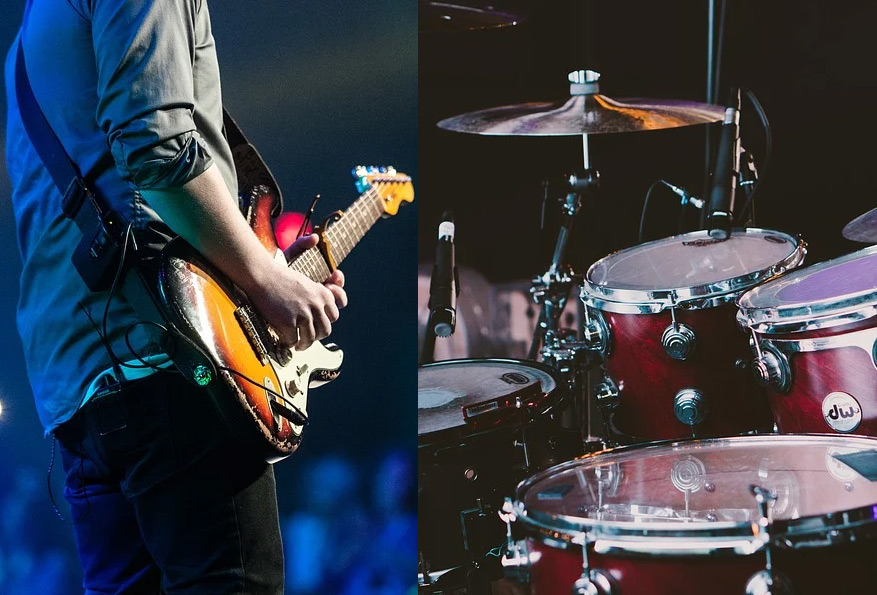
Choosing between drums and guitar is personal to each person. The drums are a larger, louder instrument that usually plays a supporting role in a band. A guitar is pitched, compact, and plays a more front-of-stage role.
Can’t decide if you should learn the drums or guitar? I will take you through the pros and cons of each, to help you figure out which one to get started with.
Which one you should go for depends on the following:
- Your personality
- Your available practice space
- Your budget
- Your natural strengths
- Your willingness to carry around heavy equipment!
If you have a strong gut feeling toward one particular instrument then that’s likely the one for you. Though going through the pros/cons of each before making your decision is recommended.
Contents
- Are the drums easier to play than guitar?
- Front of Stage Role vs Supporting Role
- If Noise is a Big Concern – Pick the Guitar!
- Transporting Gear
- Playing Guitar at a Campfire vs Hitting a Djembe at a Campfire
- Good Drummers are Usually in Demand
- drum workout
- Which is more expensive, Guitars or Drums?
- Guitar or Drums – Based On Your Personality
- Conclusion
Are the drums easier to play than guitar?
Neither drums nor guitar is automatically easier for every beginner. The drums require a solid foundation of rhythm, coordination, time-keeping, and numerous methods and techniques to become proficient at the instrument. Compare a basic groove with a simple chord change before deciding which challenge you enjoy more.
It’s easy to learn the basics of either instrument. It also takes a long time to master either instrument.
Learning any musical instrument requires patience, commitment, and dedication. Luckily, we can factor in a student’s aptitude and personality to figure out if you’re leaning toward melody or fancy rhythm instead.
The guitar is a pitched instrument that readily produces melody and harmony. A standard drum kit mainly supplies rhythm, although its drums have pitches and tom patterns can suggest melodic shapes. Guitar lessons introduce ear training (relative pitch), harmony, and music theory that includes chords, scales, modes, and substitutions. Those subjects can help drummers too. A guitarist can also diversify into acoustic, electric, slide guitar, open tunings, and classical fingerstyle playing.
The drums, on the other hand, are more groove and rhythm oriented. A drummer is not expected to add to the melody or harmony of a musical piece. Instead, they are the backbone of the rhythm section. Keeping very solid time and playing complex rhythms also takes a lot of practice.
Front of Stage Role vs Supporting Role

If you want a typical front-of-stage role, the guitar often offers that opportunity. If you enjoy driving the band from a supporting role, drums can be a good fit. These are common stage arrangements, though: guitarists also accompany others, and drummers can lead bands and sing.
A guitarist is in the limelight a lot more than a drummer would be. There is something about those Satriani-style melodies, Malmstein-like shredding, and Petrucci-esque lead lines that just electrify the audience as nothing else can.
Of course, there are drum solos, but you don’t get to unleash them quite as often, and the intricacies of your drumming are often lost on the audience.
If Noise is a Big Concern – Pick the Guitar!
The drums are loud. Kick-pedal impacts can travel through the floor, while airborne sound also travels through walls and doors. The crash seems to ring forever. The snare cuts through the dry walls like a katana.
The drums are LOUD. That is one of the main reasons they are so fun and gratifying to play. Fun for you and not so fun for the neighbors.
So, maybe no one is gonna call the cops on you when you drill rudiments on your practice pad. But at some point, you are going to start playing on a kit. And, at some point, you will want to cover Master of Puppets or Chop Suey.
At that point, you may need a suitable rehearsal room, a properly isolated garage, or a quieter setup at home. Soundproofing means limiting sound transmission; sticking foam on the walls mainly treats reflections inside the room. If you have an electronic drum kit then headphones keep the module sound private, but pad strikes and pedal vibration can still reach the neighbors.
But wait, isn’t the guitar loud too? Sure it is, and an acoustic guitar can still disturb someone in the next room. Electric guitars have pocket amps, pedals, combo amplifiers, and other devices that allow people to practice using headphones or earbuds. Check that the particular device has a suitable headphone output, since a speaker output is not a headphone socket.
So if you don’t live in one of those mansions where people go to the dining room using hoverboards or electric scooters, you should definitely consider the consequences of unhinged drumming and how to circumvent it.
Drummers already have several quieter practice options: muting pads, low-volume cymbals and heads, practice pads, or an electronic drum set with headphones. Muting pads change rebound and tone, so try them before committing. An electronic module provides headphone monitoring, but it does not silence the physical impact of sticks and pedals.
Unless you have a dedicated practice space, it’s difficult to fit in practicing on a full acoustic drum set. It doesn’t matter how good you are on the drums, there are only that many paradiddles your family, friends, and neighbors are willing to put up with!
Transporting Gear
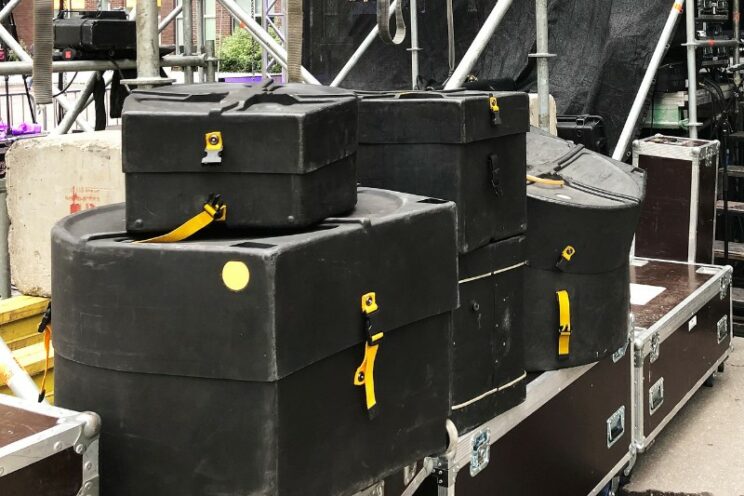
Until you have technicians and roadies to do the heavy lifting, taking your own kit to a venue means loading it, unloading it, setting it up, packing it up, and taking it home again. A shared venue or rehearsal-room kit can reduce that load. Ask exactly what is supplied, then pack your own missing essentials, such as sticks, cymbals, pedal or snare.
But fret not; semi-pro guitarists only have it slightly easier. They’ve got a 50lbs amp/cabinet and two guitars, a pedal board, and a backpack with cables and adapters. And, they have to carry it wearing leather pants in the hot summer. Close call, a really close call.
Verdict: Have you considered the harmonica or ukulele?
Playing Guitar at a Campfire vs Hitting a Djembe at a Campfire
Guitarists get all the limelight at gatherings and campfires. They will strum and croon away the night basking in the moonlight and oodles of appreciation from friends. The bad news is that many beginner guitarists will revert to Wonderwall by Oasis.
As for drummers, you can stare down the darkness while you burn your marshmallows over the bonfire. You will play at campfires too. But only for those few seconds while you clap at the end of each song. Or you could learn the djembe accompaniment to Wonderwall.
Verdict: Everyone loses, especially the marshmallows.
Good Drummers are Usually in Demand
Reliable drummers can be hard to find in some local scenes, but there is no universal rule that drum gigs are easier to get than guitar gigs. Check local musician adverts and rehearsal spaces before basing your choice on demand. Location, genre, availability and how well you work with others all affect your chances.
A good session drummer may play with several bands, especially with dependable timing, preparation and communication. Even excellent players have gaps between bookings; relationships and finding suitable work matter alongside technique.
Now, this doesn’t mean you should not learn the guitar just because there is more competition. I said too many guitarists, not too many great guitarists.
drum workout
Playing the drums can be a full-fledged workout.
Unless you are Angus Young, no guitarist can come close to the intensity and zest that goes into rocking out on the drums. The shoulder joint, elbow joint, knee joint, calf, it’s only a matter of time till someone starts selling drums as a fitness program (wait… it’s already been done… ‘cardio drumming’!).
The guitar? Not so much. Guitarists occasionally tap the distortion pedal or kick on the reverb. And, they vigorously wiggle their fingers! But the only thing worth calling active… is the pickups.
Which is more expensive, Guitars or Drums?
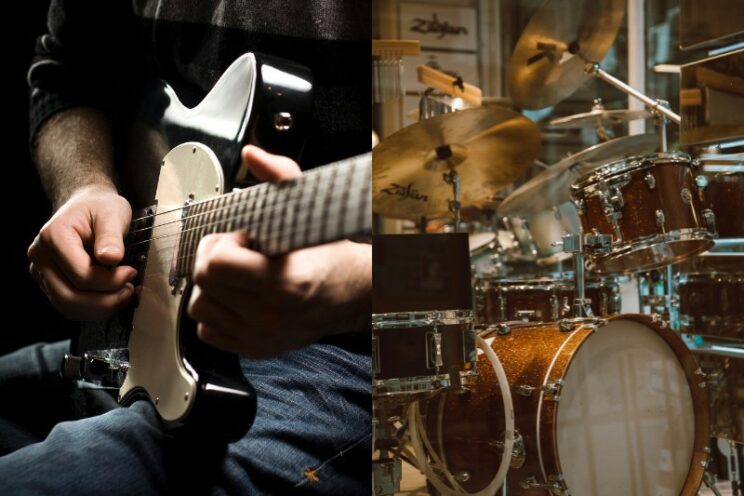
Drums are usually more expensive than guitars for beginners, but the gear prices can be similar as the player gets to the intermediate or pro level.
A complete beginner drum setup often costs more than a basic acoustic guitar, but that is not inevitable. Compare complete setups: a shell pack may omit cymbals, stands, a pedal or a stool, while an electric guitar also needs a way to hear it. Used equipment and what you already own can change the comparison substantially.
At an intermediate level (think semi-pro), the drums are often still more expensive to upgrade and maintain because of the cost of high-quality cymbals, drum heads, drum shells, and hardware.
However, semi-pro guitarists will often start stocking on various individual analog effect pedals, cabinet/amp heads, patch cables, snazzy pickups, an unnecessary bandana, and flight cases for everything. So, depending on your style, playing the guitar at an intermediate level may still be quite expensive.
At a pro level, both of them get expensive depending on your personal preferences. As far as maintenance goes, guitars frequently need new strings, cables, and picks. Their amplifiers, analog pedals, or digital guitar processor and amplifiers might need maintenance and upgrades as they continue to play.
Drum maintenance usually involves buying new drumsticks, changing skins (drum heads), and checking pedals, stands and fasteners. A cracked cymbal may need replacing, but cymbal breakage is not a routine maintenance requirement; suitable technique and mounting help avoid it.
Guitar or Drums – Based On Your Personality
You can figure out which instrument you’re leaning toward just by taking a look at your personality and how you listen to music.
When listening to songs, do you air drum or sing the melody?
Most people either have a natural affinity for rhythm or harmony/melody. The really good musicians have all three but even then one aspect will be more prevalent than the other. Which one is it for you? What is your predilection?
If you enjoy the rhythmic aspects of music and find yourself air drumming when you hear a really good song; the drums may be the right choice for you. If you enjoy the melodic aspects of music and often find yourself air-guitaring (or whistling/humming a melody); the guitar might be a better choice for you. If you enjoy doing neither of them; the bass guitar…
Do you have a strong gut feeling about which one to go for?
When you are really passionate about an instrument, none of the pros and cons will hold you back. You will find a way to make things happen. And that incessant yearning, that deep-rooted hunger, that burning desire to be a great musician may or may not entail reading an article like this.
Why not try both?
There are people, ever so often, who can neither figure out their natural affinity nor lay claim to any inherent passion. If you still can’t settle on learning the guitar or drums, then it’s best to try your hand at both.
Take a few drum lessons and guitar lessons before committing to equipment. Ask to borrow or use the teacher’s instruments, and try a short practice task on each between lessons. A few weeks can help you compare your enjoyment and practice options, though you do not have to settle on a fixed deadline. Once you are resolute, continue with the instrument of your choice.
If you’re going to learn both drums and guitar, then choose one as your primary instrument. The guitar and drums are a life-long journey. You never hear a good musician say “I’m done, I know it all.” You can choose one as your primary instrument and learn the other as a hobby.
This is quite common. Most musicians can play at least one other instrument and some play multiple instruments fairly well. Each instrument you learn will inform your perspective and add to your musicality. It isn’t a waste of your time. Just keep your priorities in check and focus on your primary instrument initially.
Conclusion
Both the guitar and drums have their pros and cons. So, in the end, if your brain isn’t being helpful, just listen to your gut! Also, take into consideration the price, portability, playability, and whether you’re gravitating toward melody or rhythm.