
The 7 Best Metronomes for Drummers (2026)

The drummer is the backbone of the music. Novice bands can be easily spotted through poor timekeeping. More experienced and skilled musicians are able to control the dynamics of their playing while holding a consistent tempo.
Drummers need to be able to play to a metronome. This is vital for both practicing and recording. An increasing amount of drummers use metronomes for their live playing. In fact, many modern bands use in-ear monitoring systems with a shared click for each band member.
When buying a metronome, it’s very useful to get one that has a headphone output. This means that you can plug earphones in (preferably noise-isolating ones) so you can more easily hear the metronome above the sound level of your drums.
My top recommended drum metronome is the BOSS DB-90. This has detailed subdivision controls, Rhythm Coach exercises, and useful connections for practice or live playing.
My second recommended drum metronome is the Korg MA-2. This is a highly affordable metronome with a headphone jack.
Contents
- The 7 Best Metronomes for Drummers (2026)
- 1. BOSS DB-90
- 2. Korg MA-2
- 3. Soundbrenner Pulse
- 4. Korg KDM-3
- 5. Korg TM-70T Black
- 6. Tama RW200 Rhythm Watch
- 7. Korg MetroClip
- Do Drummers use Metronomes?
- Why is it important for Drummers to use a Metronome?
- Are Mechanical Metronomes accurate?
- Do Drummers use Metronomes on stage?
- How many types of Metronomes are there?
- Do Drummers count in their heads?
- Do Metronomes work?
- Conclusion
The 7 Best Metronomes for Drummers (2026)

1. BOSS DB-90
The Boss DB-90 is my top pick for drummers who want detailed rhythm practice and stage connections in one device.
What makes this metronome so special is the ability you have regarding beat control. To be more precise, there are separate volume options for the stressed beat and other, smaller parts of the beat. That way, you can learn how to play accented beats vs. off-beats.
Another practice-friendly feature is that the Boss DB-90 comes with four different click options. One of them is a human voice, which is a handy feature for further customization.
With this metronome, you can also play along with some drum machine rhythms thanks to its PCM system. You can use the special Rhythm Coach option, which is something every drummer can benefit from, regardless of their experience.
You can store up to 50 metronome settings, so a practice routine or set of song tempos is easier to recall. The MIDI input accepts MIDI clock from an external sequencer; it is a synchronization connection, rather than a way to play keyboard notes through the metronome.
The trigger input works with an electronic drum pad for Rhythm Coach practice, and the built-in microphone can detect acoustic playing. A separate instrument input lets you practice guitar or bass through headphones. Finally, two headphone outputs give you a choice of plug sizes for monitoring the click.

2. Korg MA-2
The Korg MA-2 is one of the most affordable metronomes on the market. It’s simple and easy to use, with good controls, and a small display for better navigation.
When it comes to simple yet effective devices, the MA-2 will not disappoint. It includes a readable display, basic onboard controls, and a practical design. Additionally, it comes with the added tap tempo function for practice sessions or you can adjust it between 30-252 BPM.
The Korg MA-2 provides reference pitches from C4 to B4, with calibration from 410 Hz to 480 Hz. You can tune another instrument by ear against these tones, but it does not detect pitch like a chromatic tuner.
The MA-2 is small enough to keep in a stick bag, and its basic controls cover straightforward rhythm practice. It even has an auto-off feature to preserve the battery life. The headphone jack is a surprising yet welcome addition, especially when you consider the affordable nature of this metronome. You can listen to your click without filling the room with it.
Overall, the Korg MA-2 is THE metronome if you’re looking for a simplistic, functional, and affordable metronome for drumming.

3. Soundbrenner Pulse
Now for something completely different! The Soundbrenner Pulse Smart, Vibrating & Wearable Metronome is a state-of-the-art device that could significantly improve your timing without having to listen to a metronome click!
You can adjust the tempo with the outer wheel or tap a tempo on the device. The Pulse has no numerical display, so the companion app is useful for precise BPM settings. Its dedicated vibration motor provides a physical beat cue; try the wearing position that you can feel most clearly while playing.
What’s great for bands is that you can connect the Soundbrenner Pulse with up to five devices to a tablet or a smartphone and experience genuine multi-player synchronization.
You can also make your own rhythms and adapt the time signatures and beat subgroups to your drumming needs. What’s more, you can set the accents and raise your drumming sessions to a much higher level.
The mobile app lets you save rhythm presets and setlists. MIDI synchronization is handled through the app rather than a hardware MIDI input on the Pulse. If you plan to use it with backing tracks, check the current app setup and rehearse that connection before a show.

4. Korg KDM-3
Another Korg metronome on this list is the Korg KDM-3. Korg has certainly made it a habit of making budget-friendly yet fully-functional devices that anyone can afford. The KDM-3 is a digital metronome that resembles the old mechanical vintage design.
The design of this metronome is amazing. On the side, it includes musical terms for different BPM. On the front, you have a nice, readable display for the tempo, along with a tempo knob, and up/down beat knobs.
On the other side, there is a volume control, a 1/8″ headphone jack, and Sound, Voice Select, Timer, and Standby controls. Lastly, on top of the metronome, are the two main controls – the Start/Stop button and the Tap tempo button.
The Korg KDM-3 comes with 19 beat patterns and 8 metronome sounds, along with a wide tempo range from 30 to 252 BPM. You can even select duplets, triplets, claves, and more.
The reference tones range is C4 to B4, also, the calibration range (410Hz–480Hz). For the given price, the KDM-3 sports a stylish and usable design with the features a drummer needs. Overall, it’s a very cost-effective metronome.

5. Korg TM-70T Black
The Korg TM-70T is a two-in-one device with a metronome and a chromatic tuner. These two functions can work at the same time or separately. It replaces the TM-60 here because the current model has a smaller body and an updated display, while keeping the useful tuner/metronome format.
The LCD has a needle-style tuning meter, a backlight, and a folding stand. That is handy in a rehearsal room or a dark studio. The black unit linked here is the TM-70T base model: the separate TM-70C package includes a CM-400 contact microphone, so do not assume that microphone comes with this one.
Sound Back plays the reference note closest to the pitch you put into the tuner. This lets you compare what you hear with the meter, rather than relying on the display alone. The tuner covers C1 to C8 and adds transposition for F, B-flat, and E-flat instruments.
For rhythm practice, you get a range of 30 to 252 BPM, tap tempo, and 15 rhythm variations. Some subdivisions are unavailable while the tuner and metronome run together. For drumming alone, the simpler MA-2 is enough; this is a more useful choice if you also play guitar, bass, or another pitched instrument. A chromatic tuner does not replace judging the feel and sound of your drum heads.
| Tempo | 30 to 252 BPM |
| Rhythm variations | 15 |
| Tuner range | C1 to C8 |
| Package | Black TM-70T base unit; contact microphone sold separately |
Pros
- Combines tuning and rhythm practice in a compact unit
- Backlit display and headphone connection
- Tap tempo and Sound Back for practice
Cons
- Several subdivisions are restricted during simultaneous tuning
- Extra tuner functions add little for drum-only practice
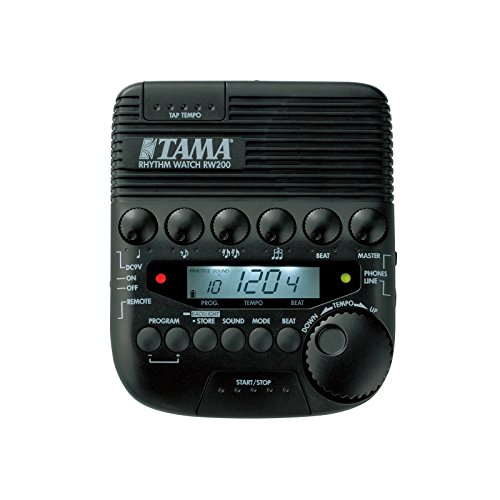
6. Tama RW200 Rhythm Watch
A product of the renowned manufacturer of drummer’s equipment, the Tama RW200 Rhythm Watch is a reasonable option for different types of drummers.
For starters, it comes with a small, but practical display. Because of the large font used for the numbers, the tempo you’re playing is easily visible regardless of the quality of your vision. The tempo options range from 30 to 250 BPM, which is more or less a usual feature for metronomes in general.
The quick dial option on the front part of the Tama RW200 enables you to set the tempo on the go. This is a practical option for fast studio sessions or live gigs. You can save up to 30 programs containing tempo, beat, and sound settings, which is a time-saving feature.
In addition to the large knob for tempo adjustments, some smaller knobs on the front let you set various beat subgroups. All these additions will help you fine-tune the right groove for your drumming sessions.

7. Korg MetroClip
The Korg MetroClip is my visual-tempo alternative. It replaces the older KDM-2, whose desktop speaker role is already covered by the current KDM-3. Rather than putting another box on a table, you can clip this one to a stand or clothing and angle it into your line of sight.
The display offers Bounce, Flash, and left/right modes. Flash mode makes the strong beat brighter than the weaker beats, while Bounce gives you a moving cue. This is useful if you want a visible pulse near your music or practice pad instead of trying to hear a small speaker above the kit.
Its tempo range is 30 to 300 BPM, with beat settings from 0 to 12 and subdivisions for eighth notes, triplets, and sixteenth notes. A ball joint helps you aim the display, and one AAA battery powers the unit. The built-in piezo speaker also provides a click.
I would choose it for practice where the visual cue is the main attraction. For a live click feed through headphones or a stage mixer, the DB-90 or RW200 is the better choice. Visual timing and audible timing feel different, so try the display with a simple groove before relying on it for a difficult part.
| Tempo | 30 to 300 BPM |
| Beat settings | 0 to 12 |
| Display modes | Bounce, Flash, left/right |
| Power | One AAA battery |
Pros
- Clips near your score or practice position
- Adjustable viewing angle and three display modes
- A different way to follow time without raising the click volume
Cons
- Does not provide the dedicated headphone or line-output role of a stage metronome
- Fewer practice and memory options than the DB-90
Do Drummers use Metronomes?
Most drummers that are serious about their instrument use a metronome for practicing. The number one job of a drummer is to stay on time, and a metronome is a tool that they use to improve this. However, drummers are not the only ones who can benefit from their use, pianists, guitar players, and singers often turn to metronomes to improve their timing.
Why is it important for Drummers to use a Metronome?
A competent drummer can stay on time consistently. If a drummer does not practice to a metronome, at least some of the time, then they miss a useful way to develop this skill. Of course, some people have a very good internal sense of time to start with. However, it is generally not close to the level that a drummer needs to be at.
Are Mechanical Metronomes accurate?
Yes, mechanical metronomes are very accurate, especially if you buy a good-quality one. However, you can be a lot more accurate with selecting your desired BPM when using a digital metronome.
Do Drummers use Metronomes on stage?
Many drummers use a type of metronome during live shows using in-ear monitors (this is known as a click track). It’s very common, but it is not quite as common as how often drummers practice with them. Using click tracks on stage is very important when playing along with backing tracks or other gear that is synced to a particular BPM.
How many types of Metronomes are there?
There are two basic types of metronomes: A mechanical/analog one, and a digital one. Many digital metronomes are more practical for drummers because you can connect headphones and hear the click while playing. Wearable and visual models offer other ways to follow the beat, so check the connections of the exact model you choose.
They’re also particularly useful if you use an acoustic drum set, as mechanical metronomes will be difficult to hear over the sound of the kit.
Do Drummers count in their heads?
Drummers often count in their heads as a way of training their rhythm. It’s quite an important element when practicing drums and can make it quite a bit more effective.
Do Metronomes work?
A metronome, when used properly and often, will certainly help you improve your timing and rhythm very effectively. Your improvements in rhythm will quickly translate into being able to play along with backing tracks and with other musicians.
Also, if you ever want to record drums, then you’ll certainly need to be able to play along with a metronome.
Conclusion
Playing drums with a metronome might seem tedious at first. However, it’s one of the best ways to skyrocket your time-keeping ability, which is your most vital skill as a drummer. In line with that, casual and amateur drummers as well as professional drummers can find a suitable metronome for themselves.
My top recommended drum metronome is the BOSS DB-90. This has detailed subdivision controls, Rhythm Coach exercises, and useful connections for practice or live playing.
My second recommended drum metronome is the Korg MA-2. This is a highly affordable metronome with a headphone jack.




