
The Different Types of Drums – Your Ultimate Guide

The family is as diverse as the members, although each one is distinctive. Different types of drums include drum sets, marching drums, bongos/congas, goblet drums, frame drums, tongue drums, timpani, and steel drums.
This is your ultimate guide to the different types of drums that you can find all around the world.
This will be useful for anyone curious to learn about all the different types of drums available. It will also be a great guide for musicians that wants to pick up a new percussion instrument, but are not sure which one to go with!
Contents
Drum Sets
Drum set types: Acoustic, Electronic, Hybrid
Acoustic Drum Sets
Acoustic drum sets use drum heads and metal cymbals to produce dynamic sounds with a lot of subtlety and variance.

If you want to get the best depth of sound then acoustic drums are usually the best option.
A drum set consists of:
- Snare drum which is usually placed in the center of the drummer, and this gave us a loud cracking sound
- Tom toms, which are different sizes and are usually tuned to create a series of compatible pitches.
- Bass drum which is played using a beater, and a kick pedal.
- Drum Hardware and pedals to bring everything together.
- Cymbals such as hi-hat, ride, and crash cymbals.
- Other effects and percussion instruments, such as tambourine, cowbell, concert toms, jam blocks, etc, are based on the preference of the drummer.
Electronic Drum Sets
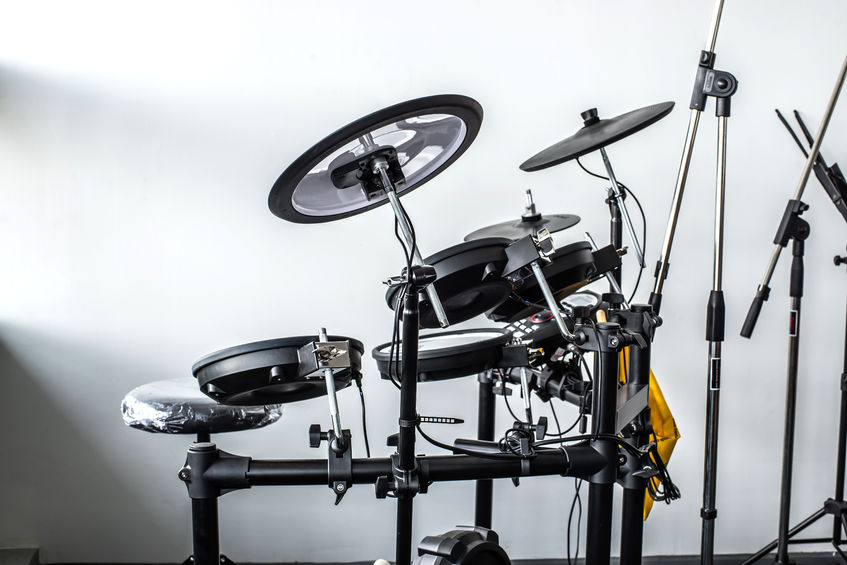
Electronic drum sets produce less acoustic sound, are often more compact and can be a better option for people to practice, due to noise constraints. Electronic drums also allow you to bring out many different types of sounds from your set. Pad impacts and pedal vibration remain audible, even when you monitor through headphones, so they are quieter rather than silent.
Therefore, they have a more versatile array of sounds than acoustic drums have. However, they do not have the depth of sound that acoustic drums have. (That said, flagship models are coming reasonably close, such as the Roland Td 50)
An electronic drum set usually consists of:
- drum module which produces the sounds
- Drum and cymbal pads
- Pedals for hi-hat and bass drum sounds (which may also include a kick drum pad/tower)
- Hardware to bring everything together.
Hybrid Drums
Hybrid drums are a combination of acoustic and electronic, and they come in many different forms. Drummers usually create their own hybrid drum set themselves based on their needs, such as using drum pads or drum triggers. You can read all about that in our hybrid drums section.

A hybrid drum set can consist of:
- Acoustic drums
- Electronic drums
- Electronic sample and percussion pads
- Drum triggers
- Hybrid cymbals
- Drum trigger module
- …and more
Latin American hand drums
Drum types: Congas, bongos, cajons, tambora, plenera

Hand drums are very popular across Latin America and the Caribbean, where they are a consistent part of local folk music. The instruments below come from different places, so their shared popularity does not mean they all originated in South America.
Congas and bongos, among others, became very well-known worldwide as unmissable protagonists of salsa, merengue, bachata, and Latin jazz.
Congas, sometimes called tumbadoras, are tall, narrow, single-headed drums originating from the Afro-Cuban folklore.
Conga players may use one drum or a set. Common commercial size names are quinto (highest pitch), conga (middle pitch), and tumba (lowest pitch). Tuning and the musical role also affect pitch, and a player does not need all three sizes to start.
The name comes from la conga, a drum used in traditional Cuban carnivals.
Congueros can use five basic strokes: the open tone (played with four fingers by the edge of the skin), the tono ahogado (holding the fingers on the skin to muffle the sound), the tono bajo (achieved by striking the full palm), the tono seco, and the toque de punta.
Some other popular Latin hand drums are the tambora (originated in the Dominican Republic) and the plenera, a Puerto Rican frame drum.

Another extremely popular hand drum, now also employed in any pop acoustic setting, is the cajón, a wooden box originally from Peru, that was quickly extended to flamenco and jazz.
In conclusion, hand drums are a fascinating mix of different styles and cultures. Playing them requires a lot of skill, achievable only through restless practice!
Marching drums
Main types of marching drums: marching snare drum, multi tenor, and marching bass drum.
Marching Snare Drum

A marching snare drum works in a similar fashion snare use on a drum set, but it is often much deeper and tuned to a much higher level. They also include snare wires on the bottom (resonant) head to give it that cracking sound. Marching drummers often benefit from the use of a special type of drum key to get very high tension on their snare drum.
Marching Bass Drum

The marching bass drum is also very similar to the bass drum that you would have on a drum set. The only difference is that it’s mounted on the marching drummer’s shoulders and played by beaters in the drummer’s hands. The marching bass drum can be quite heavy so the marching drummer needs to have a good degree of strength to be able to hold this for a long time.
Interesting note: The Lambeg drum is a very large type of bass drum, that is used by unionists in Northern Ireland. It is an exceptionally loud acoustic instrument, and the drummer usually needs to wear a neck harness, because these drums are just so heavy (up to 40 pounds or 18 kg)! The drums are hit with a material similar to bamboo.

Multi-tenor
Multi tenor drums are drums of different pitches and sizes, all held on one unit. The marching drummer can then roll back and forth between these using mallets or drumsticks
Goblet drums
Drum types: Djembes; related hand drums include ashiko and bougarabou

Djembes fall under the category of goblet drums, so-called for the shape of their body, on which a membrane is mounted.
Goblet drums are popular in Africa, Asia, and Eastern Europe.
The African djembes are possibly the most well-known goblet drum in the Western world.
A djembe usually has a body made of hard and dense wood, while the membrane is usually goatskin, mounted on the body through a rope and two steel rings.
Its name probably comes from the Bambara saying Anje djé, anke bé, meaning “Let’s gather together in peace”.
Considering its size, a djembe can project strongly enough to lead an ensemble. Its loudness depends on the instrument, stroke, room, and measurement distance, so a single decibel figure does not describe every djembe. It also offers a big variety of sounds, making it a great instrument for solo interludes over an ensemble.
The three main sounds used by players are the bass (low pitch), the tone (medium pitch), and the slap (high pitch), resulting from different striking techniques in different areas of the membrane.
For example, to play the bass sound you’ll have to hit the drum with the palm of your hand, towards the center of the skin. To play either the tone or the slap sound, instead, you’ll have to play closer to the edges.
Other African hand drums include the ashiko and the bougarabou. The ashiko has a tapered, conical body rather than the djembe’s goblet shape.
Frame drums
Drum types: tambourines, bodhran, tar, daf, ghaval, ocean drum

As highlighted above, the tambourine is possibly the most known frame/hand drum. It is so popular that we can find various versions of it in different genres and cultures, from folk music to rock, from South America to Europe (Italy, Greece, Turkey,…).
Tambourines probably originated in Ancient Egypt and were also used by the Hebrew people for religious rituals. The term has a French origin (tambour means “drum”, although it seems to originate from the Arabic tunbur or Middle Persian tambur).
The peculiarity of a tambourine lies in the metal chimes (zills) attached to its structure (usually made of wood or plastic), which give the instrument a bright, jolly sound.
We all must have played the tambourine at some point in our childhood, but mastering a performance with this seemingly easy instrument is trickier than it sounds. The hand techniques you could employ are various, and you could even use your legs, hips, or a stick to produce sounds of different intensities and characteristics by stroking the frame. Or you could not stroke the frame at all and go for a tambourine roll, rapidly rotating your wrist while holding the instrument in your hand.
In our times, tambourines are extremely popular in rock and pop music and are often played by the lead singer of a band (think about Mick Jagger or Robert Plant) or the drummer, who can have them mounted along with their cymbals.
Frame drums are very common in Middle Eastern music too. Many traditional instruments from the Middle East and North Africa are actually frame drums you can play with bare hands.
Examples include the tar, the daf, or the ghaval. All these three have similar structures, made of a wooden frame with skin on top of it. These instruments can be played with the palm of your hand, with your fingers, or with sticks and hammers, according to the intensity of sound you want to achieve.

A very similar kind of instrument is the Irish bodhran, which has a comparable structure but is usually played with a traditional stick (cipìn).
With this kind of drum, the differences in sound and pitches are mostly attributed to their materials. Their modern versions often have tuners.
The ocean drum is a really interesting type of frame drum, that has beads inside that was made to mimic the sound of the ocean.
Talking Drum
The talking drums were used by West African griots to make music that was similar to that of their indigenous ancestors. It is shaped like an hourglass and the pitch can be changed by the player while they are playing the drum.
There are many different sizes of the talking drum, with the size of the drum varying across ethnic groups.
It has drum heads on either side connected by tension cords. The player holds the drum under the arm and squeezes the cords to tighten the heads and raise the pitch while striking the drum. Skilled players can imitate the intonation and rhythm of tonal speech, rather than simply a humming sound.
The Hang, Handpans, and Steel Tongue Drums

These are a group of melodic percussion instruments that are rich in tone and expression.
The ‘Hang‘ is a very interesting and specific instrument introduced by the Swiss company PANArt in the year 2000 (The company didn’t like it being called a ‘hang drum‘, and in fact, probably would rather it not be included in this article at all!).
Many other producers of similar instruments emerged – these instruments are more specifically referred to as handpans (though casual observers can often refer to all these types of instruments as ‘Hang Drums’).
These are often handmade, and quality varies between makers. Compare the tuning, finish, included case, and after-sales support before choosing one. Check out our article on handpans to learn more. Be sure to stay clear of sellers who use the high-value reputation of handpans to charge a premium for poorly tuned instruments!
Another group of instruments known as Steel Tongue Drums has also emerged. They are often smaller and cheaper than handpans, though they are based on a similar tone layout. Some even include built-in piezo microphones and tuning magnets.
All of these instruments are usually made on a single scale (apart from certain models which have a limited amount of tuning possibilities through magnets). The benefit of this is that you can hit anywhere and you won’t be out of key. The drawback is that you’re limiting your sound possibilities to a specific key.
Steelpans (Steel Drums)

The steelpan (also known as a steel drum) is a pitched percussion instrument that developed in Trinidad and Tobago. Its tuned metal note areas vibrate without a drumhead, making it an idiophone. You can get some great vibes from these and they are versatile enough to play full melodies.
The steelpan is one of the most recognizable drums and has become a characteristic sound of the Caribbean.
Steel drums have featured in many famous songs and tracks over the years, while often being sampled and used in lots of different music styles.
The Timpani

The timpani is a kettle drum that is used very regularly in orchestral music. These drums are very heavy and they have a drum head, which is tuned using a pedal.
A timpani player is called a timpanist. This is a very skilled and difficult job to have in an orchestra. Timpanists must hear and adjust pitches accurately, choose suitable mallets, and control the start and end of each note. Pedal tuning changes the head tension so one drum can play several pitches within its range.
Therefore, the next time you see a timpanist playing in an orchestra. They’re not just banging on the drum, the tuning method and style of play requires a lot of experience, and quite simply put, a lot of guts, to perform live on stage. So check out our article on the timpani for more information about this great instrument.
Summary
Drums are among the oldest musical instruments known to humanity, they originated in many different cultures, and they formed an important role in early tribal groups.
The diversity of drums that we have seen in this article shows just how prevalent drumming has been throughout the world. The style of drums is often a clue into the culture and the style of music that it was played with.
Many simple-looking drums can be deceivingly difficult to play well. The fact that you can play hand drums with bare hands could mislead you into thinking that they are fairly “easy” instruments. They are not!
First of all, there are many different kinds of hand drums, each of them with specific characteristics and sounds. Secondly, hand drums can be played with different techniques, often involving the use of sticks or hammers too.
We hope this article has served as a great guide for you to understand the different types of drums in the world.




